



What's Happening?
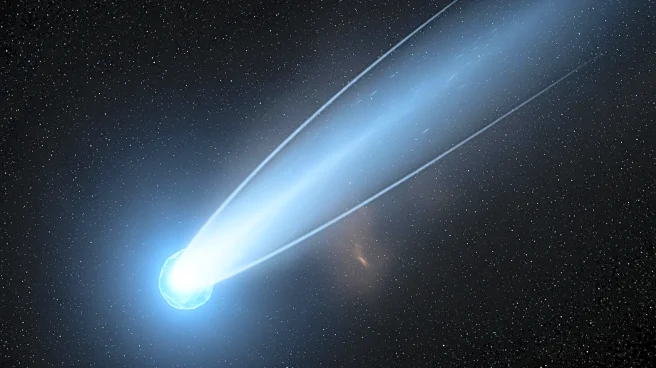
Comet 3I/ATLAS, the third known interstellar object, is currently traveling through the inner solar system at approximately 130,000 mph. Discovered in June, the comet is set to make its closest approach to Earth on December 19, at a distance of about
170 million miles. Recent images from NASA and the European Space Agency (ESA) show the comet becoming more active as it nears the sun, with its nucleus and coma visible. The Hubble Space Telescope and ESA's Jupiter Icy Moons Explorer (Juice) have captured detailed images, revealing the comet's bright and active state as it releases gas and dust.
Why It's Important?
The observation of comet 3I/ATLAS provides valuable insights into interstellar objects and their behavior as they interact with the solar system. The data collected by NASA and ESA can enhance our understanding of cometary composition and dynamics, contributing to broader astronomical research. The comet's study also underscores the capabilities of current space technology in capturing and analyzing distant celestial phenomena, highlighting the importance of continued investment in space exploration.
What's Next?
As comet 3I/ATLAS continues its journey, further data from the Juice mission is expected to be transmitted to Earth by February 2026. This data will provide more detailed information about the comet's composition and activity. The ongoing observation of 3I/ATLAS by various spacecraft will continue to offer opportunities for scientific discovery and may inform future missions targeting interstellar objects.