


What's Happening?
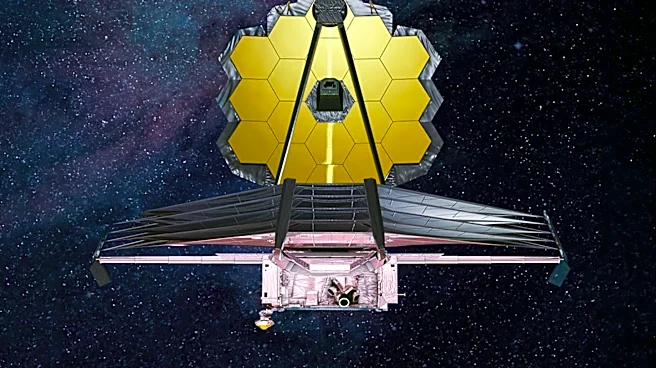
Observations from the James Webb Space Telescope (JWST) have revealed that the gas swirling around Sagittarius A* (Sgr A*), the supermassive black hole at the center of the Milky Way, is unusually rich in 'metals' (elements heavier than hydrogen and helium).
Researchers at McGill University's Trottier Space Institute, led by Nicole Ford, found that this metal-rich gas, likely supplied by exploded stars, offers clues to why Sgr A* consumes material more slowly than other supermassive black holes. The chemical composition of the gas, which includes elements like carbon, oxygen, iron, and gold, influences how quickly it cools, directly affecting the black hole's accretion rate. The study also noted that the gas composition is similar to that of stars orbiting Sgr A*, suggesting a shared origin.
Why It's Important?
This discovery is crucial for understanding the feeding mechanisms of supermassive black holes and their impact on galactic evolution. The unique metal-rich composition of the gas around Sgr A* provides a specific context for its relatively slow consumption rate, offering insights into the complex interplay between black holes and their immediate environments. By studying Sgr A*, the closest supermassive black hole to Earth, scientists can gain a better understanding of similar processes in more distant galaxies. The findings also contribute to our knowledge of how metals are distributed throughout the universe and how these elements, essential for planet formation and life, are recycled through stellar processes. This research helps to refine models of black hole accretion and the chemical evolution of galaxies.
What's Next?
Future research will focus on comparing these JWST observations with simulations of gas evolution over longer timescales to fully understand how Sgr A* attracts and consumes material. This will involve developing more sophisticated models that incorporate the effects of metal-rich gas on cooling and accretion rates. The findings also open avenues for investigating whether the metal-rich gas around Sgr A* can provide a reliable history of past black hole outbursts, although a previous study suggested that local conditions might obscure such records. Continued observations with advanced telescopes like JWST will be essential to gather more data and refine our understanding of the dynamics at the galactic center.
Beyond the Headlines
The discovery of metal-rich gas around Sgr A* highlights the intricate chemical processes occurring in the galactic center, which are fundamental to the cosmic cycle of matter. The fact that the gas and orbiting stars share a similar composition suggests a common origin, implying a complex history of star formation and stellar death in this extreme environment. This research not only deepens our understanding of black holes but also provides a window into the origins of the elements that make up our solar system and, ultimately, life itself. The use of the James Webb Space Telescope, with its unprecedented capabilities, underscores the transformative power of advanced astronomical instrumentation in pushing the boundaries of human knowledge about the universe.