







What's Happening?
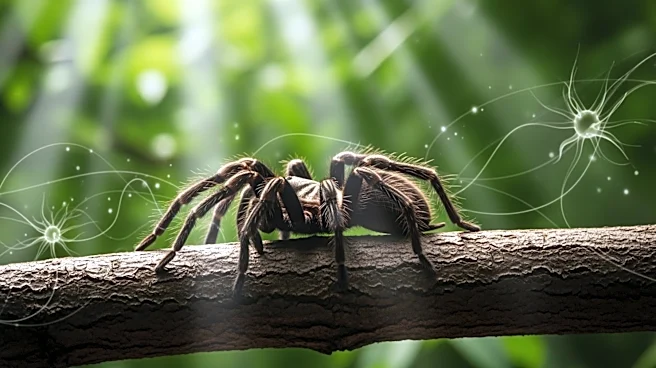
Researchers have observed tarantulas exhibiting learning-based navigation and cue-based orientation in their hunting behavior. The study, conducted by Alireza Zamani from the University of Turku, Finland, and independent researcher Rick C. West, involved
nine cases of tarantula movement and hunting across North and South America. The findings suggest that tarantulas may possess the ability to learn and remember spatial locations, adapting their hunting strategies based on past experiences. This behavior, known as spatial learning, has been noted in both arboreal and fossorial tarantulas, including the blind cave-dwelling species Hemirrhagus sprousei. The study highlights the potential for tarantulas to use both external environmental cues and internal body signals to navigate.
Why It's Important?
The discovery of learning-based hunting behavior in tarantulas challenges traditional assumptions about the cognitive capabilities of these arachnids. This finding could have broader implications for understanding the evolution of learning and memory in invertebrates. It suggests that tarantulas, and possibly other similar species, have more complex nervous systems than previously thought, allowing for flexible behavior and adaptation to environmental changes. This research could influence future studies on animal cognition and behavior, potentially leading to new insights into the neural mechanisms underlying learning and memory in non-mammalian species.