






What's Happening?
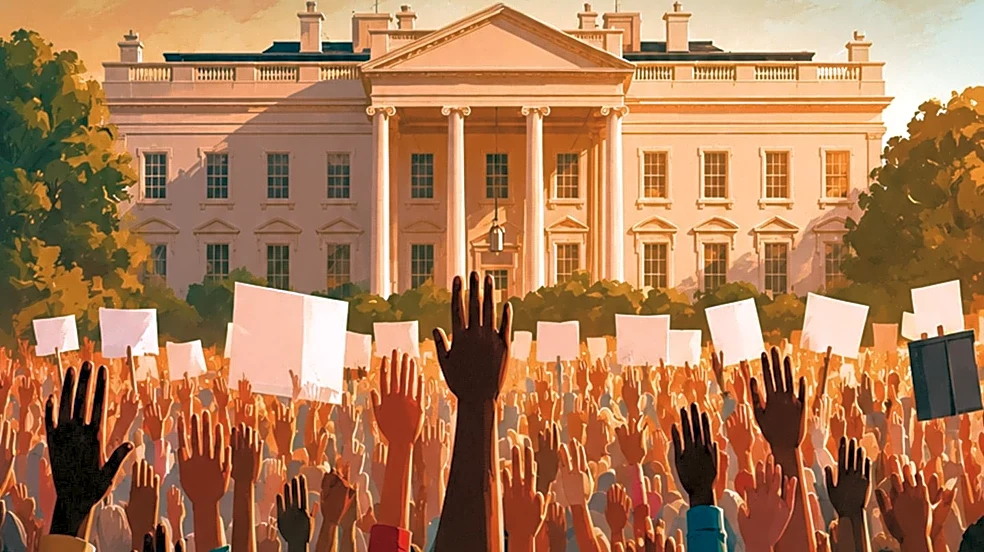
On October 21, 1967, nearly 100,000 Americans gathered in Washington, D.C., to protest the Vietnam War, with 50,000 marching on the Pentagon. This demonstration marked one of the largest antiwar gatherings in American history, reflecting growing public
frustration with the conflict. Protesters, including college students, religious leaders, civil rights activists, and veterans, first assembled near the Lincoln Memorial before proceeding to the Pentagon, the headquarters of the United States Department of Defense. The event featured speeches and appeals for peace. Tensions escalated when demonstrators confronted military police and federal marshals, leading to hundreds of arrests. Images from the protest, such as a young demonstrator placing flowers into soldiers' rifle barrels, became powerful symbols of the era's political and cultural divisions. By 1967, the U.S. was deeply involved in the Vietnam War under President Lyndon B. Johnson, with hundreds of thousands of troops in Southeast Asia. Public confidence in the Johnson administration was deteriorating, with support for the war falling below 50 percent.
Why It's Important?
The 1967 March on the Pentagon is a significant event in American history, highlighting the power of public protest and the deep divisions caused by prolonged warfare. It demonstrated the increasing influence of organized antiwar activism, which challenged government decisions and demanded public accountability. The widespread dissatisfaction with the Vietnam War, fueled by mounting casualties and escalating financial costs, led to a decline in public confidence in the Johnson administration. This erosion of trust was further exacerbated by President Johnson's proposal for a tax increase to finance military operations. The protest, while not immediately altering American policy, underscored the growing public opposition that would eventually contribute to President Johnson's decision not to seek re-election in 1968. The event's imagery and the confrontations between protesters and authorities became enduring symbols of the turbulent 1960s, reflecting a critical period of social and political unrest in the United States.
What's Next?
Although the 1967 demonstration did not immediately change American policy, it set the stage for continued antiwar activism and further erosion of public support for the Vietnam War. The following year, the Tet Offensive would deliver another significant blow to public confidence, contradicting official assurances of impending victory. This continued pressure from public opinion and the ongoing challenges of the war ultimately led to President Johnson's announcement in March 1968 that he would not seek re-election. The sustained antiwar movement and the changing political landscape eventually contributed to the withdrawal of American combat troops in 1973 and the end of the war with the fall of Saigon in April 1975. The legacy of the March on the Pentagon continues to serve as a reminder of the constitutional right to assemble and challenge government decisions, influencing future protest movements and discussions on national security and public accountability.
Beyond the Headlines
The March on the Pentagon transcended a simple protest against a single conflict, becoming a lasting symbol of American citizens' constitutional right to assemble and voice dissent against government decisions. The ethical implications of the war, particularly the mounting casualties and the perceived lack of transparency from the administration, fueled a profound moral questioning among various segments of society. The event also highlighted a significant cultural shift, as traditional notions of patriotism and civic duty were challenged by a generation increasingly skeptical of authority and government narratives. The images of peaceful protesters confronting armed soldiers underscored the tension between civil liberties and state power, prompting ongoing debates about the limits of protest and the role of the military in domestic affairs. This demonstration contributed to a broader re-evaluation of American foreign policy and the responsibilities of a democratic government to its citizens, leaving an indelible mark on the nation's political and social consciousness.