



What's Happening?
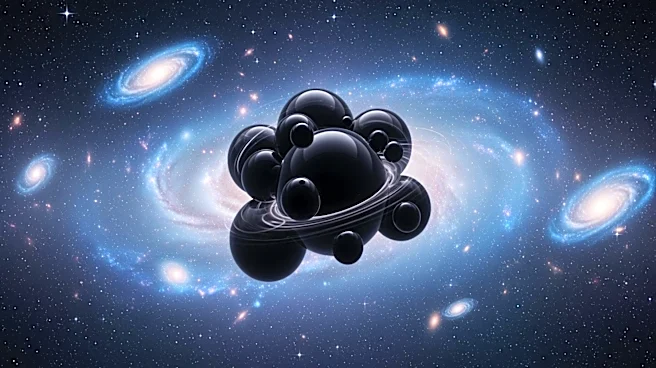
A new study published in the journal Physical Review D suggests that dark matter, the elusive and invisible substance that makes up a significant portion of the universe, could be composed of 'relic' black holes. These black holes are theorized to have
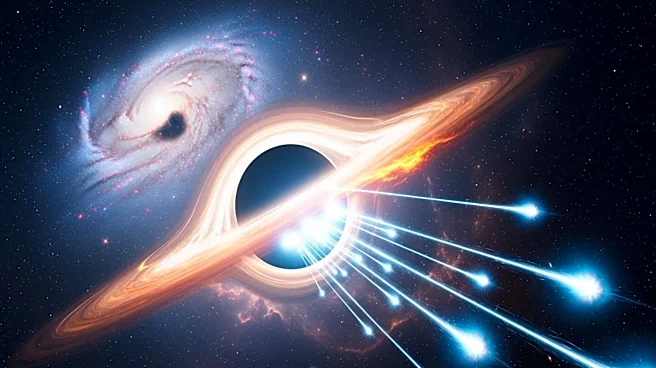
survived the collapse of previous universes, according to physicist Enrique Gaztanaga. The study explores the 'Big Bounce' theory, which posits that the universe undergoes endless cycles of expansion and contraction. Primordial black holes, which are thought to have formed just seconds after the Big Bang, are central to this hypothesis. Unlike typical black holes formed from dying stars, these primordial black holes could have originated from the extreme conditions of the early universe. Gaztanaga's model suggests that these relic black holes could have survived the transition from a collapsing universe to an expanding one, potentially making up a significant portion of dark matter.
Why It's Important?
The implications of this theory are profound for our understanding of the universe. If relic black holes indeed constitute a major component of dark matter, it could reshape current astrophysical models and eliminate the need to search for new particles or forms of physics to explain dark matter. This theory also offers a potential explanation for the existence of supermassive black holes that formed shortly after the Big Bang, which current models struggle to account for due to the time required for such massive structures to form. The study challenges existing paradigms and could lead to new insights into the fundamental nature of the universe, influencing future research directions in cosmology and particle physics.
What's Next?
Further research is needed to test Gaztanaga's theory against empirical data. This includes analyzing gravitational-wave backgrounds, conducting galaxy surveys, and making precision measurements of the cosmic microwave background. These efforts will be crucial in determining the validity of the relic black hole hypothesis and its role in dark matter composition. The scientific community will likely engage in extensive debate and experimentation to explore the feasibility of this model, potentially leading to groundbreaking discoveries in the field of astrophysics.