




What's Happening?
In 2021, a team of paleontologists led by Charles Marshall at Berkeley estimated that approximately 2.5 billion Tyrannosaurus rex lived over the 2.4 million years the species existed. Despite this vast number, only about 32 relatively well-preserved post-juvenile
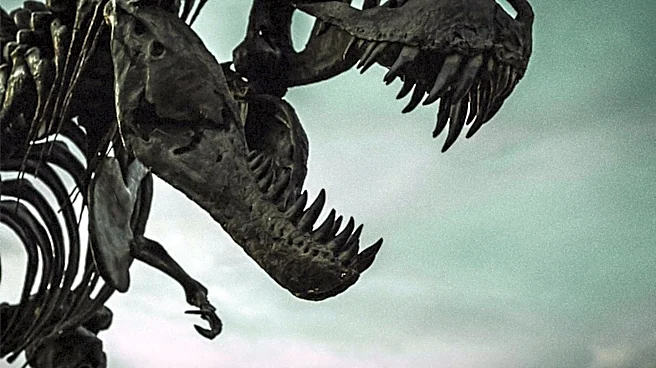
specimens are held in public museums. This estimate underscores the rarity of T. rex fossils, with roughly one specimen found for every 80 million that lived. The first partial skeleton was discovered in 1902, and since then, fewer than a hundred individuals have been identified, many represented by a single bone. The fossilization process is rare, requiring specific conditions for preservation, which explains the scarcity of specimens.
Why It's Important?
The study highlights the challenges in paleontology, where the fossil record captures only a tiny fraction of prehistoric life. This scarcity affects our understanding of ancient species, as much of what is known about T. rex is based on limited evidence. The findings emphasize the importance of careful scientific extrapolation and the need for continued exploration and study to fill gaps in the fossil record. The rarity of fossils like T. rex also impacts museum displays and educational content, as they rely on a few well-preserved specimens to represent entire species.