
What's Happening?
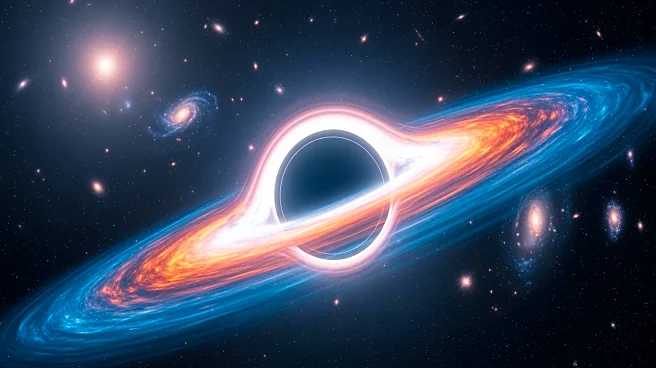
Astronomers have observed a star 'wobbling' around a black hole, providing the first evidence of a swirling vortex in spacetime, a phenomenon predicted by Einstein's theory of general relativity. The study,
conducted by the National Astronomical Observatories at the Chinese Academy of Sciences, focused on a tidal disruption event (TDE) where a star was torn apart by a supermassive black hole. The resulting disk of stellar remnants exhibited rhythmic changes in X-ray and radio signals, confirming the Lense-Thirring precession effect. This discovery offers new insights into black hole spin, accretion physics, and jet formation, marking a significant advancement in astrophysics.
Why It's Important?
This observation is crucial as it confirms a century-old prediction of general relativity, enhancing our understanding of black holes and their influence on surrounding cosmic objects. The findings provide a new method for studying black hole dynamics and the mechanics of spacetime, potentially leading to breakthroughs in astrophysics. By demonstrating the frame-dragging effect, the study opens avenues for further research into the gravitational interactions between massive celestial bodies and their environments. This could have implications for our understanding of the universe's fundamental forces and the behavior of matter under extreme conditions.
Beyond the Headlines
The confirmation of the Lense-Thirring precession effect not only validates Einstein's theory but also highlights the intricate relationship between mass, rotation, and spacetime. This discovery underscores the importance of continued investment in astronomical research and technology, as it enables scientists to explore and understand complex cosmic phenomena. The study also emphasizes the collaborative nature of modern astrophysics, involving international teams and advanced observational tools. As researchers delve deeper into the mechanics of black holes, they may uncover new aspects of the universe's structure and evolution, potentially influencing future scientific and philosophical perspectives on space and time.