




What's Happening?
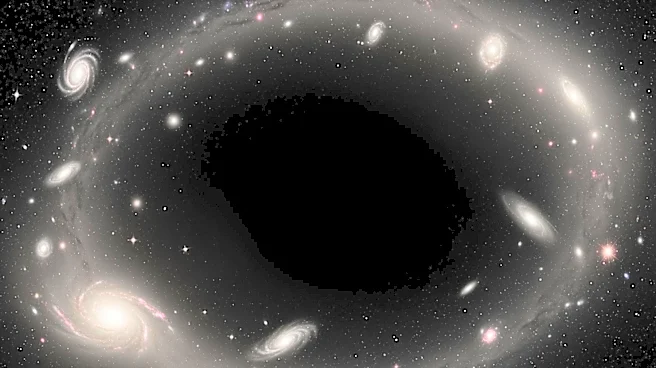
Cosmic voids, once considered empty expanses between galaxies, are now seen as promising tools for understanding the universe's biggest mysteries. These vast regions, mostly free of matter, may hold solutions to persistent cosmic questions such as the behavior
of gravity, the nature of dark energy, and the Hubble tension, which is an observational mismatch in the universe's expansion rate. Researchers like Alice Pisani from the Centre for Particle Physics in Marseille highlight the high signal-to-noise ratio in these voids, allowing for clearer observations. Recent advancements in telescopes and computational simulations have significantly enhanced the study of these voids, enabling scientists to model and observe them with greater precision.
Why It's Important?
The study of cosmic voids is crucial as it could lead to breakthroughs in understanding fundamental aspects of the universe. By providing a clearer view of cosmic phenomena with less interference from matter, voids allow researchers to test theories about gravity and dark energy more effectively. This research could potentially resolve the Hubble tension, a major issue in cosmology that affects our understanding of the universe's expansion. The insights gained from studying voids could influence future cosmological models and theories, impacting how we perceive the universe's structure and evolution.
What's Next?
As technology continues to advance, the study of cosmic voids is expected to grow, with new telescope surveys like the Dark Energy Survey Instrument and the European Euclid space telescope set to map thousands of voids. These efforts will provide unprecedented data, allowing scientists to explore these structures in greater detail. The ongoing research may lead to new discoveries about the universe's composition and the forces that govern it, potentially reshaping our understanding of cosmology.