


What's Happening?
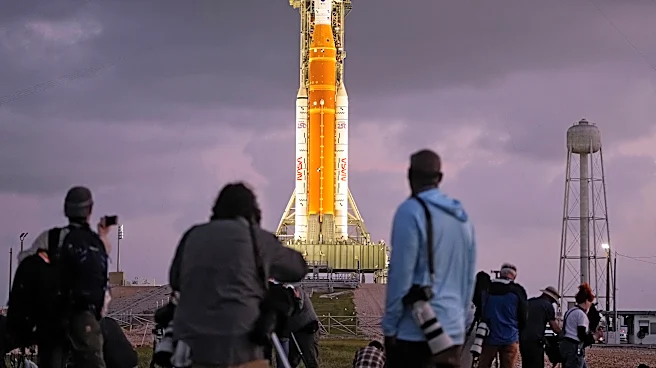
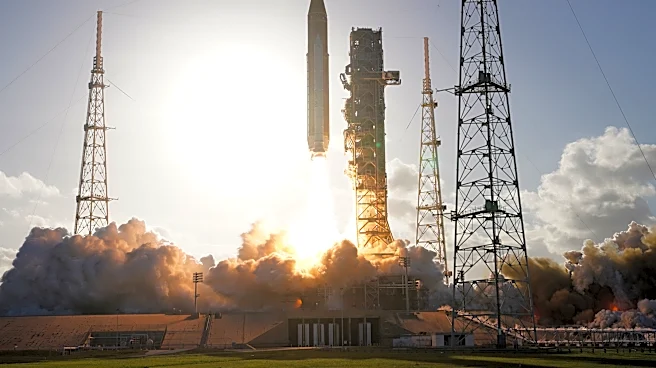
NASA has successfully launched the Artemis II mission from Kennedy Space Center in Florida, sending four astronauts on a historic journey around the moon. This mission marks the first time humans have traveled beyond low-Earth orbit in over 50 years.
The Artemis II crew consists of NASA astronauts Reid Wiseman, Victor Glover, and Christina Koch, along with Canadian Space Agency astronaut Jeremy Hansen. The mission is a significant step in NASA's plan to return humans to the moon and eventually send astronauts to Mars. The launch was executed without major issues, despite some technical challenges that were resolved prior to liftoff. The crew will spend nearly 10 days in space, conducting extensive systems checks and testing the spacecraft's capabilities for deep space travel.
Why It's Important?
The Artemis II mission is crucial for the future of human space exploration, as it lays the groundwork for future lunar landings and potential missions to Mars. This mission demonstrates the United States' commitment to leading in space technology and innovation. The successful launch and execution of Artemis II could bolster public and governmental support for NASA's long-term goals, including establishing a sustainable human presence on the moon. Additionally, the mission serves as an inspiration for a new generation, many of whom were not alive during the Apollo missions, highlighting the continued importance of space exploration in advancing scientific knowledge and international collaboration.
What's Next?
Following the successful launch, the Artemis II crew will conduct a series of systems checks in high Earth orbit before performing a critical engine burn to set the spacecraft on a trajectory towards the moon. The mission will include a lunar flyby, where the spacecraft will travel farther from Earth than any human has in decades. After completing their journey around the moon, the crew will return to Earth, with the Orion capsule re-entering the atmosphere and splashing down in the Pacific Ocean. The mission's success will be evaluated to inform future Artemis missions, including Artemis III, which aims to land astronauts on the lunar surface.