



What's Happening?
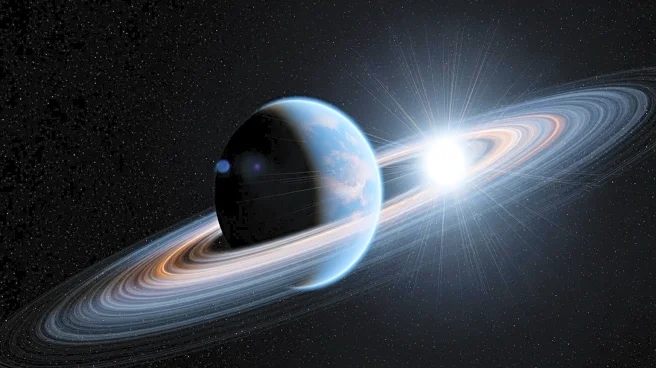
The James Webb Space Telescope (JWST) has discovered an exoplanet, PSR J2322-2650b, orbiting a pulsar in the constellation Sculptor. This exoplanet is notable for its unusual helium-and-carbon-dominated atmosphere, which includes molecular carbon and soot
clouds. The planet, with a mass similar to Jupiter, is distorted into a lemon shape due to the intense gravitational pull of its pulsar host. The pulsar's gamma-ray emissions allowed for detailed spectroscopic analysis of the exoplanet's atmosphere, revealing a composition unlike any previously observed. The discovery challenges existing planetary formation theories, as the exoplanet's characteristics do not align with known processes for typical planet formation or 'black widow' system evolution.
Why It's Important?
This discovery is significant as it challenges current understanding of planetary formation and atmospheric composition. The unique carbon-enriched atmosphere of PSR J2322-2650b suggests alternative formation mechanisms that differ from traditional models. The findings could lead to new insights into the processes that govern planetary and atmospheric development in extreme environments. Additionally, the ability to study the exoplanet without interference from its host star's luminosity provides a clearer understanding of its atmospheric properties, potentially influencing future exoplanetary research and exploration strategies.
What's Next?
Further research is needed to understand the formation and evolution of PSR J2322-2650b. Scientists may explore the possibility of carbon condensing into diamonds within the planet due to intense internal pressure. The study of this exoplanet could lead to the identification of other similar systems, expanding knowledge of planetary diversity in the universe. Continued observations using JWST and other telescopes will be crucial in unraveling the mysteries of this and other exotic exoplanets.
Beyond the Headlines
The discovery of PSR J2322-2650b raises questions about the classification of planetary systems, particularly those involving pulsars. The potential for carbon crystallization in the planet's atmosphere could have implications for understanding the chemical processes in extreme environments. This finding also highlights the importance of advanced telescopic technology in uncovering new astronomical phenomena, paving the way for future discoveries that could redefine existing scientific paradigms.