
What's Happening?
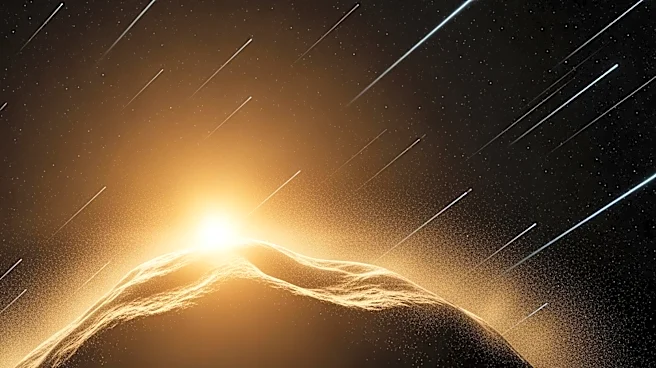
A new meteor shower has been discovered, originating from an asteroid that is being broken down by the Sun. This finding was made by scientists who study meteors using camera observations from networks
in Canada, Japan, California, and Europe. The shower consists of 282 meteors, indicating that the asteroid got too close to the Sun, causing its surface to crack and release dust and gases. This process is similar to the activity seen in comets, which release dust as they pass by the Sun. The discovery highlights the dynamic nature of asteroids and their potential to shed material, contributing to meteor showers observed on Earth.
Why It's Important?
The discovery of this meteor shower is significant for understanding the physical evolution of asteroids and comets in our solar system. It provides insights into how these objects change over time due to external forces like solar heat. Additionally, meteor observations offer a unique method to study objects that are invisible to traditional telescopes, revealing hidden populations of near-Earth asteroids. This information is crucial for planetary defense, as it helps identify potentially hazardous asteroids that could pose a threat to Earth. The findings also contribute to the broader understanding of solar system dynamics and the interactions between celestial bodies.
What's Next?
The parent asteroid of the new meteor shower remains unidentified, but efforts are underway to locate it. NASA's NEO Surveyor mission, set to launch in 2027, will play a key role in this search. The mission is dedicated to planetary defense and aims to discover dark, Sun-approaching asteroids. This space telescope will be instrumental in identifying the source of the meteor shower and enhancing our understanding of asteroid activity. Continued research and observation will be essential in tracking and studying these celestial phenomena.