



What's Happening?
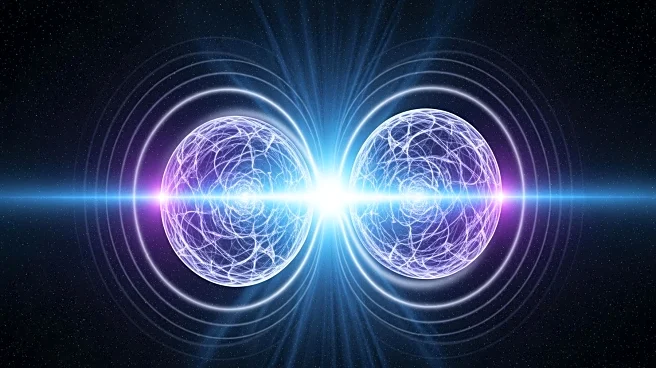
NASA researchers have conducted the most comprehensive simulations to date of the moments leading up to the collision of two neutron stars. Utilizing the Pleiades supercomputer, these simulations focus on the magnetospheres, the highly magnetized regions
surrounding these dense stars, as they spiral towards a merger. The study, published in The Astrophysical Journal, reveals the chaotic interactions of magnetic fields and the resulting high-energy emissions. These findings are significant as they provide potential signals that could be detected by future observatories, offering insights into gamma-ray bursts, the universe's most powerful explosions. The simulations detail how the magnetospheres behave like a magnetic circuit, continually rewiring as the stars orbit, which could influence both electromagnetic and gravitational wave signals.
Why It's Important?
The significance of these findings lies in their potential to enhance our understanding of gamma-ray bursts and the dynamics of neutron star mergers. By identifying electromagnetic signals that could be detected by future telescopes, the research opens new avenues for multi-messenger astronomy, which combines gravitational wave and electromagnetic observations. This could lead to a more comprehensive understanding of these cosmic events. The study also highlights the importance of perspective in observing these phenomena, as the emitted light's intensity and direction vary greatly. This research could inform the design and focus of future observatories, potentially leading to breakthroughs in our understanding of the universe's most energetic events.
What's Next?
Future observatories, both ground and space-based, are expected to hunt for the pre-merger electromagnetic signals identified in these simulations. These efforts will complement gravitational wave detections, providing a more complete picture of neutron star mergers. The research suggests that magnetic stresses, although secondary to gravity, could leave an imprint on gravitational wave signals, offering a new dimension to these observations. As technology advances, the ability to detect these signals will improve, potentially leading to significant discoveries in astrophysics and a deeper understanding of the universe's most powerful explosions.