
What's Happening?
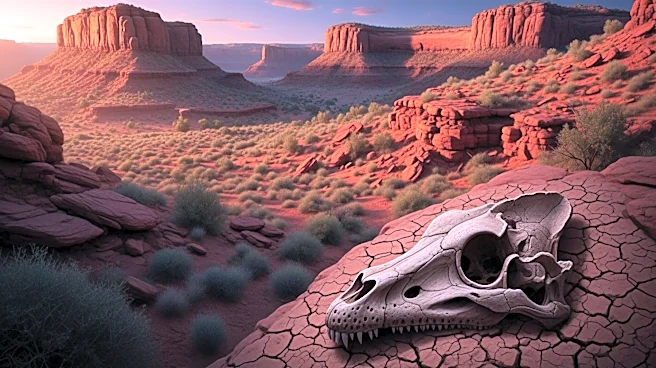
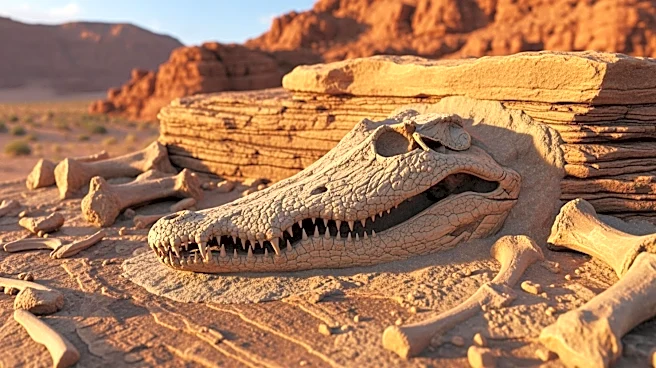
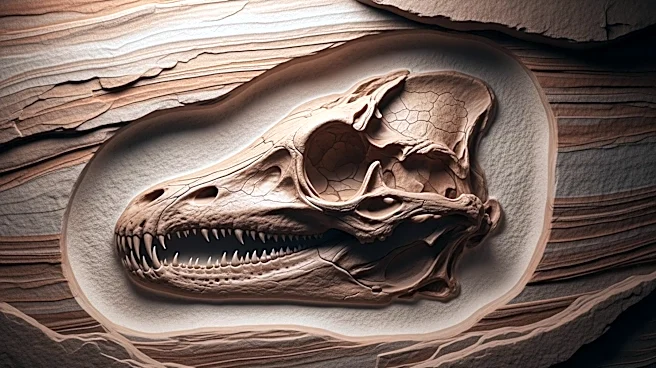
Scientists have identified a new prehistoric reptile species, Labrujasuchus expectatus, from fossils found in a Triassic quarry in New Mexico. This species, which lived approximately 212 million years
ago, is a distant relative of modern crocodiles. Unlike its relatives, it had a beak, no teeth, and tiny arms, and walked on two hind legs. The discovery was made by a team led by Alan Turner, a professor of anatomical sciences at Stony Brook University. The findings, published in the Journal of Vertebrate Paleontology, highlight subtle differences that distinguish this species from other North American shuvosaurids.
Why It's Important?
The discovery of Labrujasuchus expectatus provides valuable data for understanding the evolutionary history of reptiles. It illustrates the diversity and complexity of prehistoric life and the evolutionary experiments that occurred over 200 million years ago. Such findings help scientists reconstruct ancient ecosystems and understand extinction patterns. The research also demonstrates convergent evolution, where similar body plans evolve independently in unrelated species. This discovery adds to the knowledge of how ancient reptiles adapted to their environments, offering insights into the evolutionary processes that shaped the diversity of life on Earth.