







What's Happening?
Westinghouse has issued a Part 21 report to the Nuclear Regulatory Commission (NRC) regarding a defect in motor cutoff switches used in safety-related circuit breakers at 13 U.S. nuclear power plants. The issue stems from springs inside these switches being
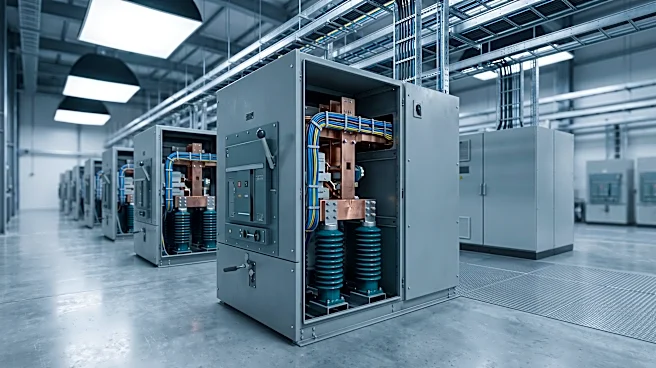
colored with acrylic paint instead of the specified dye. This acrylic paint has the potential to flake off and generate foreign material, which could accumulate between the switch's moving and stationary contacts. If enough paint particles build up, the electrical resistance could increase, preventing the switch from making proper electrical contact. While the defect does not affect the breakers' ability to open on demand, it could cause them to fail to close. These motor cutoff switches are crucial components that tell the charging motor when to wind up the large spring responsible for closing the breaker. The affected plants span from New Hampshire to Arizona, including Braidwood, Byron, Clinton, Callaway, Catawba, Columbia, Comanche Peak, South Texas, Palo Verde, Seabrook, Sequoyah, Wolf Creek, and Vogtle. Westinghouse recommends replacing any affected switches that serve a safety function as soon as plant scheduling permits.
Why It's Important?
This defect poses a significant safety concern for the U.S. nuclear power industry. In nuclear plants, many safety systems, such as emergency pumps and fans, are designed to be de-energized until an accident signal requires their activation. For these systems to function, their associated breakers must close to supply power. A breaker that cannot close due to this defect means critical safety equipment might not receive power during an emergency, potentially compromising the plant's ability to respond to an incident. Although no failures in service have been reported, the potential for such a failure necessitates immediate attention. The incident highlights the critical importance of quality control in the supply chain for nuclear safety components, even for seemingly minor details like the coloring of a spring. The reliance on decades-old switchgear, maintained through rebuild kits and spare parts, underscores the need for rigorous oversight of all components, regardless of their age or perceived simplicity. The NRC's involvement ensures transparency and mandates corrective action across the affected facilities, reinforcing the regulatory framework designed to prevent safety hazards in nuclear operations.
What's Next?
Westinghouse has logged this deviation in its corrective action program with a resolution due date in the first quarter of 2027. The company plans to rework the dedication process for the affected part and engage with its suppliers to address the dye-versus-paint mix-up. The 13 affected nuclear plants are now tasked with identifying and, where necessary, replacing the suspect motor cutoff switches. For breakers whose safety function is solely to open, Westinghouse still recommends verifying the closing-circuit resistance. This process will likely involve detailed inspections, procurement of compliant replacement parts, and scheduled outages or maintenance windows to perform the replacements without disrupting plant operations. The NRC will continue to monitor the situation, ensuring that Westinghouse and the affected plants adhere to the corrective actions and that the safety integrity of the breakers is restored. This event may also prompt broader reviews of quality assurance protocols for commercially dedicated parts used in safety-related nuclear applications across the industry.
Beyond the Headlines
This incident underscores a broader vulnerability within complex industrial systems: the potential for seemingly minor manufacturing deviations to have significant safety implications. The use of acrylic paint instead of dye on a small spring, intended merely for identification during manufacturing, reveals how a deviation from specifications can introduce a critical failure point. This highlights the intricate balance between cost-effective manufacturing practices and the stringent demands of nuclear safety. The reliance on a supply chain that includes manufacturers like Homewood Products Corp., which originated as a Westinghouse division and continues to produce genuine parts for legacy equipment, illustrates the challenges of maintaining quality control over decades-old designs and components. The event also brings to light the concept of 'commercially dedicated parts,' where ordinary industrial components undergo extra checks for use in safety-related systems. The failure in this dedication process, where a simple dye was replaced by paint, points to potential gaps in oversight or execution within this critical certification pathway. This could lead to a re-evaluation of how such parts are qualified and monitored throughout their lifecycle, emphasizing that even the smallest components can be critical failure points in a large, complex system like a nuclear power plant.