





What's Happening?
Jorge Dubcovsky, a distinguished professor in the Department of Plant Sciences at the University of California, Davis, and a Howard Hughes Medical Institute researcher, has been named the 2026 World Agriculture Prize Laureate. This prestigious award,
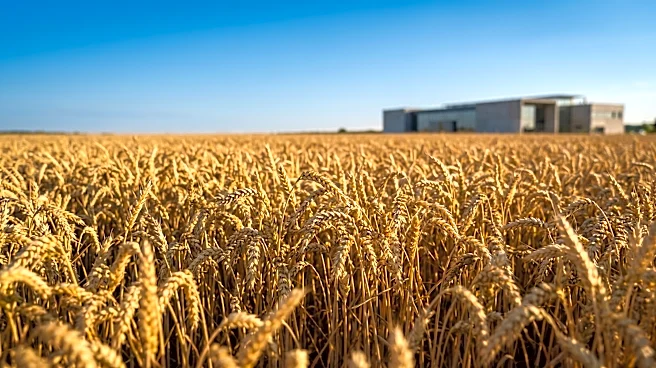
presented by the Global Confederation of Higher Education Associations for the Agricultural and Life Sciences (GCHERA), recognizes his groundbreaking scientific achievements in improving wheat and bolstering global food security. Dubcovsky is internationally acknowledged as a leading wheat geneticist, whose research over three decades has significantly advanced the understanding of wheat biology and accelerated the application of genomic technologies in crop improvement. His discoveries have led to the development of more productive, resilient, and climate-adapted wheat varieties, which are now cultivated on millions of hectares worldwide. The award ceremony will take place on October 28, 2026, at Nanjing Agricultural University in China, where agricultural, scientific, educational, governmental, and industrial leaders will gather to celebrate his contributions.
Why It's Important?
Professor Dubcovsky's recognition with the World Agriculture Prize underscores the critical importance of agricultural research in addressing global challenges, particularly food security. Wheat is a fundamental staple crop, providing essential nutrition for billions of people worldwide. His work directly impacts the resilience and productivity of this vital resource, offering solutions to the increasing demands of a growing global population and the pressures of climate change. The development of climate-adapted and disease-resistant wheat varieties is crucial for farmers, ensuring more stable yields and reducing economic vulnerability. For the U.S., this research reinforces its leadership in agricultural science and innovation, contributing to both domestic food stability and international aid efforts. The application of genomic technologies in crop improvement, as pioneered by Dubcovsky, represents a significant advancement in agricultural science, promising more efficient and sustainable farming practices globally. This achievement highlights the profound impact that scientific excellence can have on real-world issues, benefiting both producers and consumers.
What's Next?
Professor Dubcovsky's work is expected to continue influencing wheat breeding programs and agricultural research globally. The formal recognition at the World Agriculture Prize Award Ceremony in China will likely bring increased attention and potential funding opportunities to his ongoing research and the field of wheat genetics. This could lead to further advancements in developing even more resilient and productive wheat varieties, crucial for adapting to future environmental changes and feeding a growing population. His collaborative approach, which brings together researchers, breeding institutions, governments, and international agricultural organizations, is likely to be further strengthened, fostering more widespread adoption of his discoveries. Additionally, his role as a mentor to future generations of plant scientists and breeders will ensure that his legacy of innovation and scientific excellence continues to advance agricultural practices worldwide. The broader agricultural community will look to integrate these genetic advancements into practical farming applications, aiming for enhanced food security and sustainability.
Beyond the Headlines
Professor Dubcovsky's pioneering work in wheat genetics carries profound implications beyond immediate agricultural benefits, touching upon ethical and societal dimensions of food production. His success in developing climate-adapted wheat varieties highlights the urgent need for scientific innovation in the face of global climate change, which disproportionately affects vulnerable populations. The ethical considerations surrounding genetically improved crops, while not explicitly detailed in the source, are an inherent part of such advancements, prompting ongoing debates about food safety, biodiversity, and equitable access to new technologies. Furthermore, his research contributes to the broader goal of reducing global hunger and poverty, aligning with international sustainable development goals. The recognition of his work also underscores the value of long-term, fundamental scientific research, which often takes decades to yield significant real-world impacts. This achievement serves as a testament to the power of scientific collaboration and knowledge sharing across international borders, fostering a collective approach to addressing humanity's most pressing challenges.