
What's Happening?
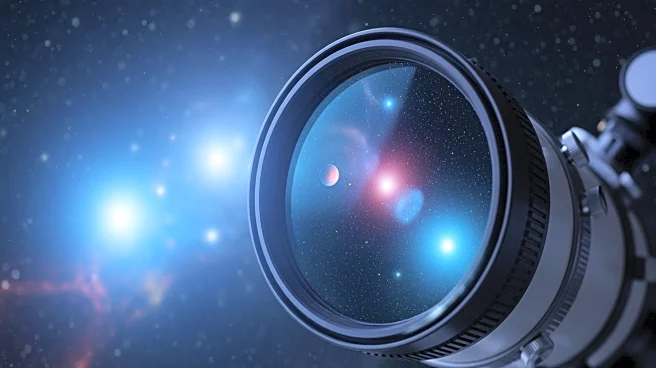
Astronomers are employing advanced telescopes to analyze the atmospheres of exoplanets in search of potential signs of alien life. By examining the gases present in these distant worlds, scientists aim
to identify molecular signatures that could indicate biological activity. The James Webb Space Telescope (JWST) plays a crucial role in this endeavor, using infrared wavelengths to detect molecules like methane, carbon dioxide, and water. These molecules leave distinct barcode-like patterns on light passing through an exoplanet's atmosphere, allowing researchers to identify them. The process is complex, as different teams may interpret data differently, but robust detections have been made. Upcoming missions, such as the European Space Agency's Plato telescope and NASA's Habitable Worlds Observatory, are expected to enhance these efforts by identifying Earth-like planets and studying their atmospheres in greater detail.
Why It's Important?
The search for extraterrestrial life has profound implications for our understanding of the universe and our place within it. Detecting signs of life on exoplanets could revolutionize fields such as astrobiology and planetary science, providing insights into the conditions necessary for life. The ability to identify molecular signatures in exoplanet atmospheres could also inform the search for habitable planets, guiding future exploration missions. This research has the potential to impact public policy and funding for space exploration, as well as inspire technological advancements in telescope design and data analysis. The discovery of life beyond Earth would have significant cultural and philosophical implications, challenging existing beliefs and expanding our understanding of life's diversity.
What's Next?
Future missions are set to enhance the search for extraterrestrial life by providing more detailed observations of exoplanet atmospheres. The European Space Agency's Plato telescope, launching in 2026, will focus on identifying Earth-like planets suitable for transmission spectroscopy. NASA's Nancy Grace Roman space telescope, scheduled for 2029, will use coronagraphic techniques to study dimmer planets orbiting nearby stars. The European Space Agency's Ariel telescope, also launching in 2029, will specialize in transmission spectroscopy to determine exoplanet atmospheric compositions. NASA's Habitable Worlds Observatory is in the planning stages, aiming to study Earth-like planets for signs of habitability. These missions will advance our understanding of exoplanetary environments and the potential for life beyond Earth.