






What's Happening?
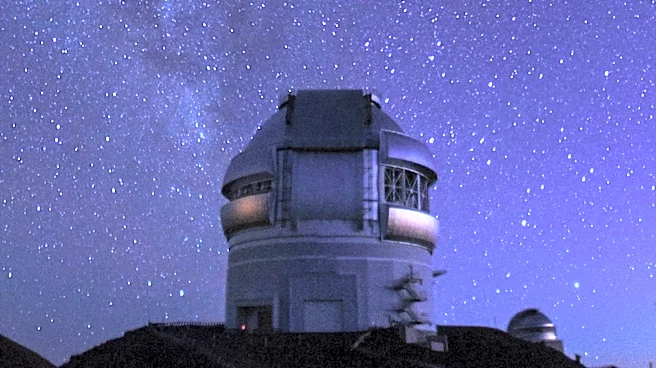
On June 23, 2025, the Vera C. Rubin Observatory in Chile activated the largest digital camera ever built, featuring 3,200 megapixels across 189 sensors. This camera, part of a project funded by the U.S. National Science Foundation and the Department of Energy,
aims to conduct a decade-long survey known as the Legacy Survey of Space and Time. The survey's objectives include exploring dark matter and searching for a potential ninth planet in the solar system. The observatory, named after astronomer Vera Rubin, who provided the first convincing evidence of dark matter, will repeatedly scan the southern sky, cataloging billions of galaxies and stars.
Why It's Important?
The activation of this powerful camera marks a significant advancement in astronomical research, particularly in understanding dark matter and the potential existence of a ninth planet. The survey's findings could reshape our understanding of the solar system's structure and the universe's mass distribution. The project also represents a substantial investment in scientific infrastructure, with a budget of approximately $810 million. The data collected will be crucial for astronomers worldwide, potentially leading to groundbreaking discoveries in astrophysics and cosmology.
What's Next?
The observatory will continue its commissioning phase throughout 2025, with the full science campaign commencing in 2026. As the survey progresses, astronomers anticipate discovering thousands of new trans-Neptunian objects and refining the search for a ninth planet. The results will be closely monitored by the global scientific community, with potential implications for future space exploration missions and theoretical models of the solar system.