





What's Happening?
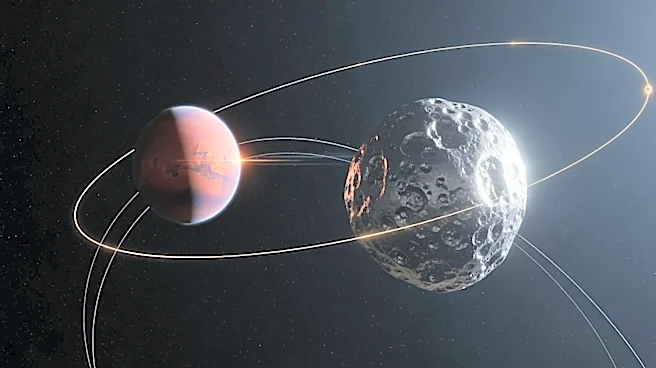
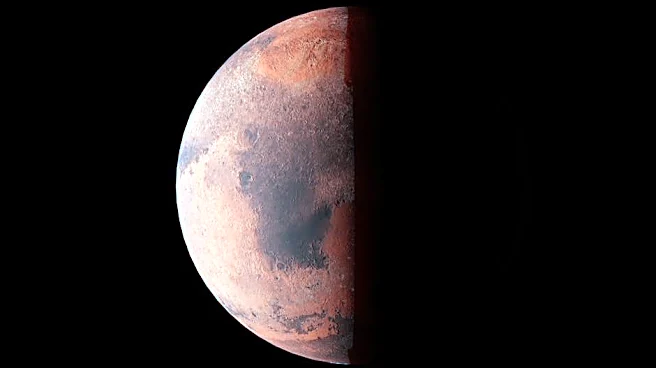
NASA's Psyche spacecraft recently executed a flyby of Mars, utilizing the planet's gravity to gain speed and adjust its trajectory towards its ultimate destination, the metal-rich asteroid Psyche. This maneuver, known as a gravity assist, allowed the spacecraft to pass
within approximately 2,800 miles of Mars, significantly boosting its velocity without the need for additional fuel. The Psyche mission aims to explore the asteroid 16 Psyche, believed to be the exposed metallic core of a protoplanet, offering a unique opportunity to study material typically found deep within planetary bodies. The spacecraft employs solar-electric propulsion, which is efficient but provides only minimal thrust over extended periods. The Mars flyby was a critical milestone, conserving fuel and setting the spacecraft on course to reach the asteroid by 2029.
Why It's Important?
The Psyche mission represents a significant advancement in space exploration, particularly in the study of planetary formation and composition. By examining the asteroid 16 Psyche, scientists hope to gain insights into the building blocks of rocky planets, including Earth. The use of gravity assists, a technique that dates back to the early days of space exploration, demonstrates the innovative strategies employed by NASA to extend the reach of its missions while minimizing costs. This approach not only conserves fuel but also allows for more ambitious missions that would otherwise be impractical. The success of the Psyche mission could pave the way for future explorations of other celestial bodies, enhancing our understanding of the solar system and beyond.
What's Next?
Following the successful Mars flyby, the Psyche spacecraft is now on a trajectory to reach the asteroid 16 Psyche by July 2029. The mission will involve detailed observations and analyses of the asteroid's surface and composition, potentially revealing new information about the early solar system. As the spacecraft continues its journey, NASA will monitor its progress and make any necessary adjustments to ensure a successful arrival. The data collected from this mission could have far-reaching implications for planetary science and our understanding of the processes that shaped the planets.