





What's Happening?
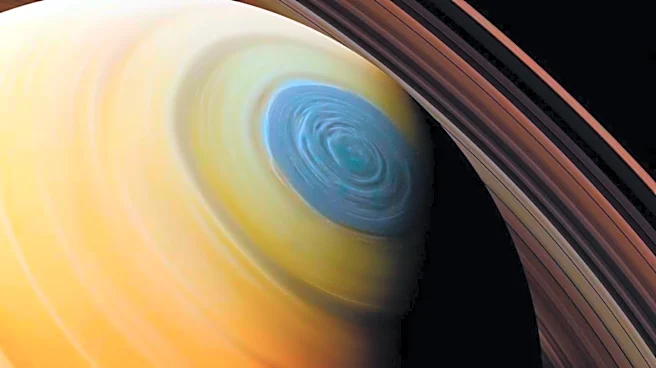
NASA's Hubble Space Telescope has identified a giant, evolving 10-sided atmospheric wave encircling Saturn's South Pole. This discovery, termed a 'decagon,' marks the first observation of a large, regular-sided jet pattern in Saturn's Southern Hemisphere.
Scientists note its similarity to the well-known hexagon in Saturn's Northern Hemisphere but believe it represents a new atmospheric phenomenon. The wave is situated within one of Saturn's powerful jet streams and extends through multiple atmospheric layers, indicating it is a vertically extended structure rather than merely a cloud-level feature. Researchers pieced together Hubble images dating back to 2023, observing subtle signs of the structure's emergence before it became a distinct pattern. These observations were part of Hubble’s Outer Planet Atmospheres Legacy (OPAL) program, which annually photographs the outer planets. The findings were published in the Journal Science Advances.
Why It's Important?
This discovery is important for advancing our understanding of planetary atmospheric dynamics and the complex weather systems on gas giants. The presence of a decagon in Saturn's Southern Hemisphere, contrasting with the long-standing hexagon in the Northern Hemisphere, provides a unique opportunity to study how such large-scale atmospheric patterns form, evolve, and interact with planetary jet streams. Observing the strengthening of this feature offers insights into the development of giant atmospheric patterns, which can inform models of atmospheric circulation not only on Saturn but potentially on other gas giants within and beyond our solar system. The fact that this structure extends through multiple atmospheric layers suggests a deeper, more fundamental process at play, challenging existing theories about planetary weather and climate.
What's Next?
Further study of Saturn's newly discovered decagon is anticipated using both the Hubble Space Telescope and NASA’s James Webb Space Telescope. These observations, combined with analysis of computer models, are crucial to determine when the atmospheric wave formed and to understand its long-term evolution. Scientists will continue to monitor the decagon's behavior and compare it with the northern hexagon to identify similarities and differences, which could reveal underlying mechanisms driving these phenomena. The ongoing data collection from the OPAL program will provide a continuous record, allowing researchers to track changes and potentially predict future atmospheric developments on Saturn. This continued research will contribute significantly to the field of planetary science.
Beyond the Headlines
The discovery of this decagon on Saturn highlights the dynamic and often unpredictable nature of planetary atmospheres, even on worlds that have been observed for decades. It underscores the limitations of our current understanding of complex fluid dynamics on a planetary scale. The contrast between the northern hexagon and the southern decagon could point to subtle asymmetries in Saturn's internal structure or energy distribution that influence its atmospheric behavior. This finding also emphasizes the value of long-term observational programs like OPAL, as subtle changes over time can lead to the emergence of entirely new phenomena. Ultimately, unraveling the mysteries of Saturn's atmospheric patterns could provide broader insights into the fundamental physics governing large-scale weather systems across the cosmos.