





What's Happening?
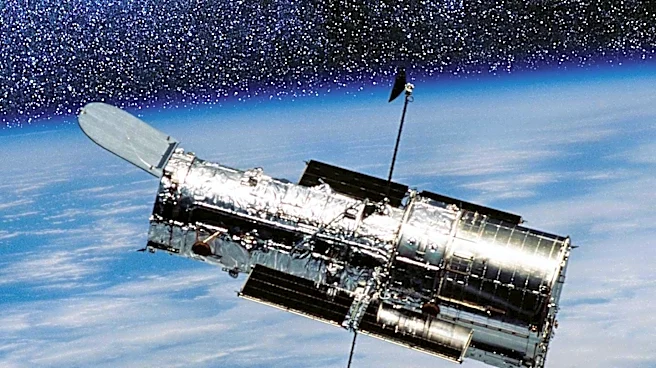
The Hubble Telescope Allocation Committee (HST TAC) has approved a wide array of research programs for astronomical observation, spanning various cycles, including Cycles 31, 32, 33, and 34. These programs involve numerous principal investigators (PIs)
from institutions across the United States and internationally, such as Northwestern University, Massachusetts Institute of Technology, University of California - Santa Cruz, and the Space Telescope Science Institute. The approved projects cover diverse areas of astrophysics, including studies of exoplanets, black holes, supernovae, galaxy evolution, stellar formation, and the composition of celestial bodies. For instance, Cycle 34 includes programs like 'Community Discovery Program: panchromatic CXO/VLA/HST observations of NS mergers' led by Wen-fai Fong, and 'Why is AGN Feedback Behaving Different in Clusters at z~1?' by Michael McDonald. Cycle 33 features 'STELa: Survey of Transiting Exoplanets in Lyman-alpha' by R. O. Loyd, and 'Where is the central black hole in the LMC?' by Anil Seth. These allocations signify a continued commitment to utilizing the Hubble Space Telescope's capabilities for cutting-edge astronomical research.
Why It's Important?
The approval of these extensive research programs by the Hubble Telescope Allocation Committee is crucial for advancing our understanding of the universe. These studies contribute significantly to U.S. and global scientific leadership in astrophysics. By investigating phenomena such as exoplanet atmospheres, the dynamics of black holes, and the evolution of galaxies, researchers gain insights into fundamental questions about the cosmos. The data collected from these observations can lead to breakthroughs in theoretical models and provide critical context for future space missions, including those involving the James Webb Space Telescope. The involvement of numerous U.S. institutions underscores the nation's role in fostering scientific innovation and collaboration. The findings from these programs have the potential to impact public policy related to space exploration funding and educational initiatives in STEM fields, inspiring future generations of scientists and engineers.
What's Next?
Following the approval, the various research teams will proceed with their scheduled observations using the Hubble Space Telescope. The data collected will undergo rigorous analysis, leading to scientific publications and presentations at conferences. Future steps will likely involve integrating these new findings with existing astronomical data, potentially leading to revised theories or the identification of new research avenues. The success of these programs will also inform future allocation cycles for the Hubble and other advanced telescopes, influencing the direction of astronomical research for years to come. Collaborations between U.S. and international institutions are expected to continue, fostering a global approach to scientific discovery. The insights gained will also be vital for planning and optimizing observations for next-generation telescopes, ensuring a continuous stream of groundbreaking discoveries.
Beyond the Headlines
Beyond the immediate scientific outcomes, the ongoing research facilitated by the Hubble Telescope has profound long-term implications. The continuous stream of discoveries about exoplanets, for example, contributes to the broader philosophical discussion about the potential for life beyond Earth. Studies on galaxy formation and evolution offer insights into the origins and ultimate fate of our own Milky Way galaxy. Ethically, the pursuit of such fundamental knowledge reflects humanity's innate curiosity and desire to understand its place in the universe. Legally, international collaborations on projects like the Hubble Space Telescope reinforce frameworks for peaceful scientific cooperation in space. Culturally, the stunning images and profound discoveries from Hubble continue to capture public imagination, fostering a sense of wonder and encouraging scientific literacy across society. This sustained exploration of the cosmos represents a collective human endeavor that transcends national boundaries and immediate practical applications.