




What's Happening?
Research teams at the NASA Glenn Research Center are conducting advanced aeroacoustics experiments in world-class facilities to reduce aircraft noise and improve engine performance. Key facilities include the 9- by 15-Foot Low-Speed Wind Tunnel (9x15
LSWT), the Aero-Acoustic Propulsion Laboratory (AAPL), the Small Hot Jet Acoustic Rig (SHJAR), and the Nozzle Acoustic Test Rig (NATR). These facilities enable researchers to study aircraft engine aerodynamics and acoustics under various conditions, such as takeoff and landing. Recent modifications to the 9x15 LSWT in 2019 improved flow and lowered background noise, while the AAPL, a 65-foot radius geodesic dome, can be configured as a hemi-anechoic or anechoic chamber to absorb sound. SHJAR and NATR are used to test nozzle designs and evaluate jet noise reduction concepts, with NATR capable of simulating flight conditions and measuring far-field noise.
Why It's Important?
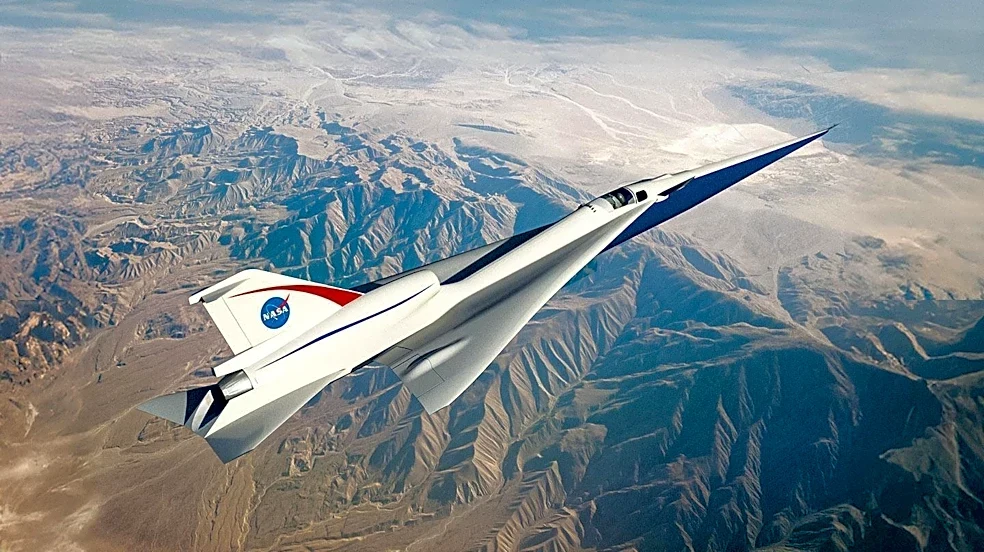
This research is crucial for addressing the environmental impact of aviation, particularly noise pollution in communities near airports. By developing quieter aircraft engines and more efficient nozzle designs, NASA aims to enhance the quality of life for residents in affected areas and enable the development of next-generation aircraft, including supersonic airliners, with reduced noise footprints. The advanced measurement techniques and diagnostic tools employed at these facilities, such as Rayleigh Scattering, Raman Scattering, and Particle Image Velocimetry, are critical for understanding the complex relationship between jet flow and noise. The findings from these experiments directly contribute to validating computer codes for jet noise prediction, which are essential for engineers to design quieter aircraft. This work supports the U.S. aerospace industry's efforts to innovate and meet increasingly stringent environmental regulations.
What's Next?
NASA Glenn Research Center will continue to utilize these specialized facilities to develop and test advanced concepts for noise reduction in aircraft engines. Future work will likely involve further refinement of nozzle designs, exploration of new engine architectures, and the application of advanced diagnostic techniques to gain deeper insights into noise generation mechanisms. The data collected will be used to validate and improve computational models, enabling more accurate predictions of aircraft noise. This ongoing research is vital for the development of future aircraft that are not only more efficient but also environmentally acceptable, potentially influencing international aviation standards and the design of commercial and military aircraft for decades to come.
Beyond the Headlines
The sophisticated aeroacoustics research at NASA Glenn Research Center has implications beyond just quieter airplanes. The fundamental understanding of fluid dynamics, turbulence, and sound propagation gained from these experiments can be applied to a wide range of fields, including industrial noise control, urban planning, and even medical imaging. The development of advanced measurement techniques, such as time-resolved particle image velocimetry and Raman-based optical methods, represents significant scientific advancements that can benefit other areas of physics and engineering. This long-term investment in foundational research underscores the role of government agencies like NASA in driving innovation that has broad societal and economic benefits, contributing to a more sustainable and technologically advanced future for the U.S. and the world.