



What's Happening?
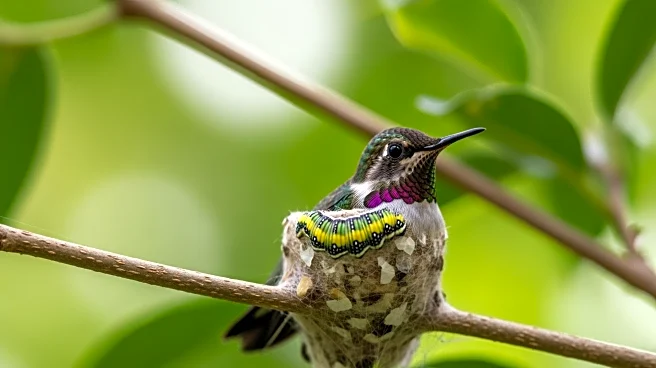
In Panama's Soberanía National Park, a baby white-necked jacobin hummingbird was observed mimicking a poisonous caterpillar to deter predators. The chick, only an inch long, exhibited behaviors such as twitching and head swinging, resembling the movements
of a caterpillar. This mimicry is believed to be a survival strategy to avoid predation in a forest teeming with threats like snakes and birds. The discovery was made by a team led by Jay J. Falk, a postdoctoral fellow at the University of Colorado Boulder, who studies hummingbird behavior and survival strategies.
Why It's Important?
This observation provides new insights into the survival strategies of young birds in predator-rich environments. The mimicry could be a crucial adaptation for survival, highlighting the complex interactions between species in tropical ecosystems. Understanding such behaviors can inform conservation efforts and enhance knowledge of avian biodiversity. The study also contributes to the broader understanding of Batesian mimicry, where harmless species imitate harmful ones to avoid predation.
Beyond the Headlines
The discovery of this mimicry behavior in a hummingbird chick suggests that similar strategies might be more common among other bird species than previously thought. It raises questions about the evolutionary pressures that drive such adaptations and the potential for other undiscovered mimicry behaviors in the animal kingdom. This finding underscores the importance of detailed field observations in uncovering the hidden complexities of wildlife behavior.