



What's Happening?
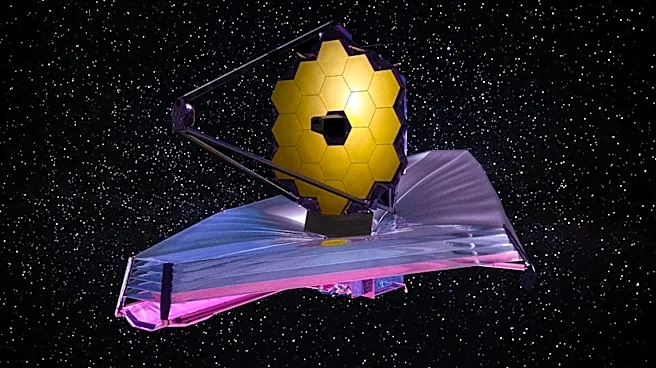
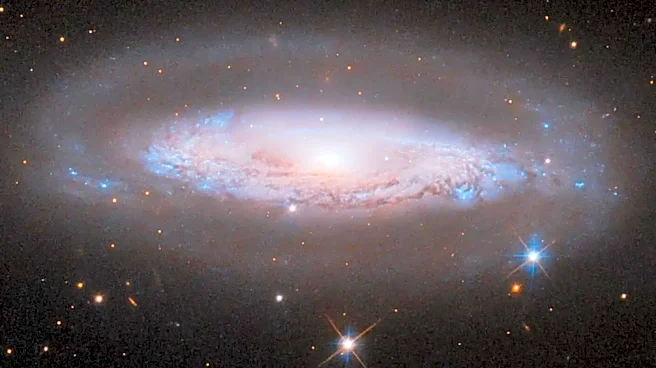
The James Webb Space Telescope (JWST) is one of the most advanced telescopes ever built, designed to observe the universe's earliest stars and galaxies. While it can look back approximately 13.5 billion years, it cannot see the Big Bang itself, which
occurred around 13.8 billion years ago. The telescope's mission is to study the period when the first cosmic objects began to emit light, providing insights into the early universe's conditions. The JWST's capabilities allow astronomers to explore the evolution of stars, galaxies, and supermassive black holes.
Why It's Important?
The JWST's ability to observe ancient cosmic phenomena is crucial for advancing our understanding of the universe's origins and evolution. By studying the earliest stars and galaxies, scientists can gain insights into the processes that shaped the universe and led to the formation of complex structures. This knowledge is fundamental to astrophysics and cosmology, influencing theories about the universe's development and the potential for life beyond Earth. The telescope's findings can also inspire future technological advancements in space exploration and observation.
Beyond the Headlines
The quest to observe the universe's beginnings raises philosophical questions about the nature of time and existence. The limitations of telescopic observation highlight the challenges of exploring phenomena that occurred billions of years ago. The JWST's mission reflects humanity's enduring curiosity and drive to understand the cosmos. As technology advances, future telescopes may push the boundaries further, potentially revealing new aspects of the universe's history. The intersection of science and philosophy in this exploration underscores the profound impact of astronomical research on our worldview.