
What's Happening?
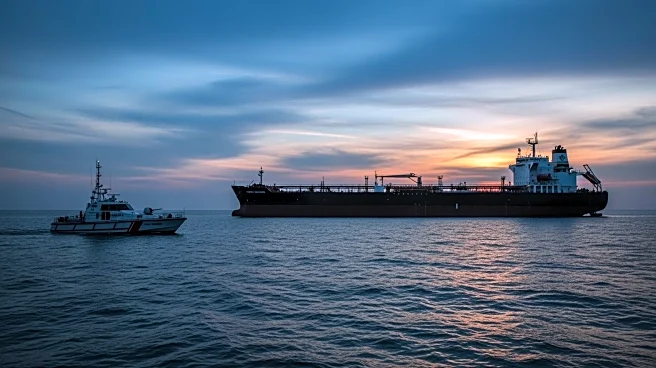
The United States has seized an oil tanker off the coast of Venezuela, intensifying its pressure on President Nicolás Maduro's government. The US Department of Homeland Security, supported by the Pentagon,
conducted the operation as part of a broader strategy to curb the illicit movement of sanctioned oil, which the US claims funds narco-terrorism in the region. The tanker, flying under the Panamanian flag, was reportedly active near the Venezuelan coast. This marks the second such seizure under President Trump's directive to blockade sanctioned oil tankers entering or exiting Venezuela. The Venezuelan government has condemned the action, labeling it as 'theft and hijacking' and a 'grave act of international piracy.' In response, Venezuela has vowed to take further steps, including filing a complaint with the United Nations Security Council.
Why It's Important?
This development is significant as it highlights the escalating tensions between the US and Venezuela, with potential implications for regional stability. The US's aggressive stance under President Trump aims to dismantle criminal networks and curb narco-terrorism, but it also risks further destabilizing Venezuela, which is already grappling with hyperinflation, poverty, and food insecurity. The seizure could exacerbate the humanitarian crisis, potentially increasing the flow of refugees into neighboring countries. Additionally, the move has sparked division among Latin American countries, with Argentina supporting US pressure while Brazil warns of a potential humanitarian catastrophe. The situation underscores the complex geopolitical dynamics in the region and the potential for broader conflict.
What's Next?
Venezuela's government has announced its intention to file a complaint with the United Nations Security Council, which could lead to international diplomatic discussions or actions. The US may continue its maritime interdiction operations, potentially leading to further seizures and increased military presence in the Caribbean. The situation could prompt reactions from other Latin American countries, either in support of or opposition to US actions. The international community will likely monitor the situation closely, considering the potential for increased regional instability and humanitarian impact.
Beyond the Headlines
The US's actions in Venezuela could have long-term implications for its relations with Latin American countries, many of which have historical grievances over US interventions. The situation may also influence global oil markets, as Venezuela holds significant oil reserves. The legal and ethical dimensions of the US's maritime operations could be scrutinized, particularly regarding international law and sovereignty. The ongoing crisis in Venezuela may also prompt discussions on the effectiveness and morality of sanctions as a tool for political change.