
What's Happening?
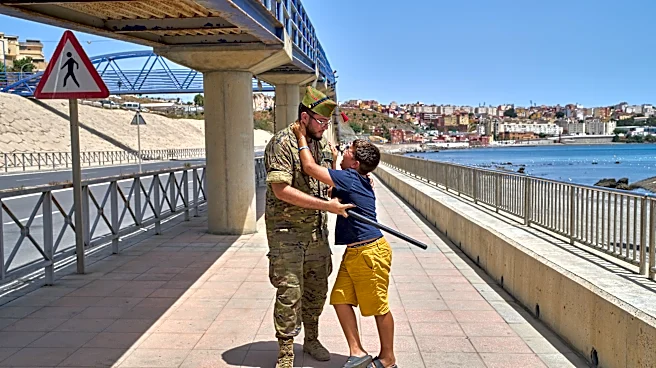
Morocco has heightened security measures at the Fnideq-Ceuta border following social media calls for a renewed mass crossing into the Spanish enclave of Ceuta. This comes weeks after a significant surge
saw approximately 49,000 people cross into Ceuta in a single day, highlighting the fragility of Europe's southern frontier. The situation has prompted Spain to deploy military and police reinforcements, with the European Union offering support through Frontex. The Ceuta-Fnideq corridor, known for its shadow economy, plays a crucial role in local livelihoods, complicating border control efforts.
Why It's Important?
The mass crossing into Ceuta underscores the complex interplay between migration, security, and economic factors in the region. The situation poses a significant challenge for Spain and the EU, as it tests the effectiveness of current border control measures and highlights the need for comprehensive strategies to manage migration flows. The economic implications are also notable, as the shadow economy in the Ceuta-Fnideq corridor is substantial, affecting local and regional stability. The crisis has the potential to influence EU border policy and cooperation with neighboring countries like Morocco.
What's Next?
The EU and Spain are likely to continue monitoring the situation closely, with potential adjustments to border security strategies and increased cooperation with Morocco. There may be discussions on enhancing Frontex capabilities and renegotiating migration cooperation agreements to better address such crises. The situation could also prompt broader EU investment in border infrastructure and technology to prevent future mass crossings.