
What's Happening?
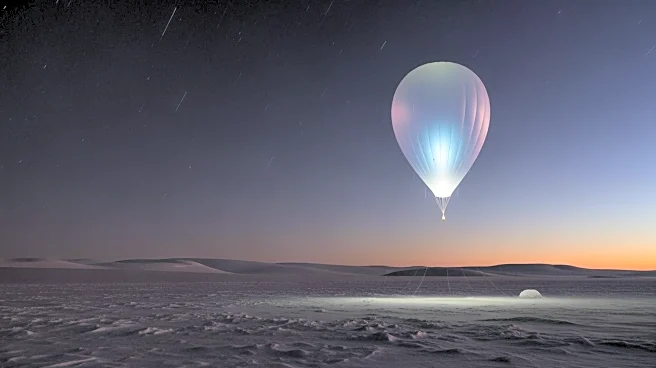
NASA has successfully launched its second scientific balloon as part of its Antarctic scientific balloon campaign. The balloon, which reached a float altitude of 120,000 feet, took off from a facility
near the U.S. National Science Foundation's McMurdo Station on the Ross Ice Shelf. The launch occurred at 5:56 a.m. NZST on December 20, which corresponds to 11:56 a.m. on December 19 in U.S. Eastern Time. The balloon is carrying the Payload for Ultrahigh Energy Observations (PUEO) mission, which is designed to detect radio signals produced when neutrinos from space collide with ice. Neutrinos are highly energetic particles, and the data collected by the PUEO payload will provide insights into cosmic events such as the formation of black holes and neutron star mergers. This mission marks NASA's first balloon launch under the Astrophysics Pioneers program, which aims to support significant astrophysics research at a reduced cost.
Why It's Important?
The launch of the PUEO mission is significant for several reasons. It represents a cost-effective approach to conducting high-impact astrophysics research, as part of NASA's Astrophysics Pioneers program. By detecting neutrinos, the mission will enhance our understanding of some of the most energetic and mysterious phenomena in the universe, such as black holes and neutron star mergers. These insights could lead to breakthroughs in astrophysics and contribute to our knowledge of the universe's fundamental processes. Additionally, the successful deployment of the balloon from Antarctica demonstrates NASA's capability to conduct complex scientific missions in challenging environments, potentially paving the way for future research initiatives in remote locations.
What's Next?
Following the successful launch, the PUEO mission will continue to collect data as the balloon remains at its float altitude. Researchers will analyze the data to identify radio signals from neutrino interactions, which could take several months. The findings from this mission may lead to further studies and potentially new missions to explore other cosmic phenomena. NASA's Astrophysics Pioneers program is likely to continue supporting similar cost-effective missions, expanding the scope of astrophysical research and potentially leading to new discoveries.