






What's Happening?
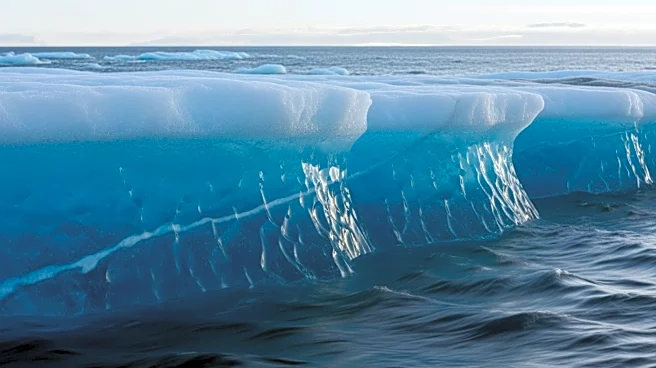
A new study led by the University of Barcelona, published in Nature Communications, reveals that Greenland's ice sheet is experiencing unprecedented melting rates. Since 1990, the surface area affected by extreme melting events has expanded by approximately
2.8 million km² per decade. The amount of meltwater produced has surged from an average of 12.7 gigatons per decade between 1950 and 2023 to 82.4 gigatons per decade since 1990, marking a sixfold increase. The study highlights that seven of the ten most extreme melting events have occurred since 2000, with significant events in August 2012, July 2019, and July 2021. Northern Greenland has emerged as a major hotspot for these changes.
Why It's Important?
The rapid melting of Greenland's ice sheet has significant global implications, including contributing to sea level rise and potential alterations in ocean circulation. These changes could have far-reaching effects on global climate patterns and coastal communities. The study underscores the urgency of addressing climate change, as projections under high greenhouse gas emission scenarios suggest that meltwater anomalies could increase threefold by the end of the century. Understanding the drivers behind these extreme melting events is crucial for anticipating future risks and informing policy decisions.
What's Next?
The study's findings emphasize the need for continued research into the processes intensifying Greenland's ice melt. As the Arctic region gains strategic importance due to environmental changes, there is a growing need for international cooperation to address the geopolitical and economic implications. Policymakers and scientists must work together to develop strategies to mitigate the impacts of climate change and protect vulnerable regions from the consequences of rising sea levels.