





What's Happening?
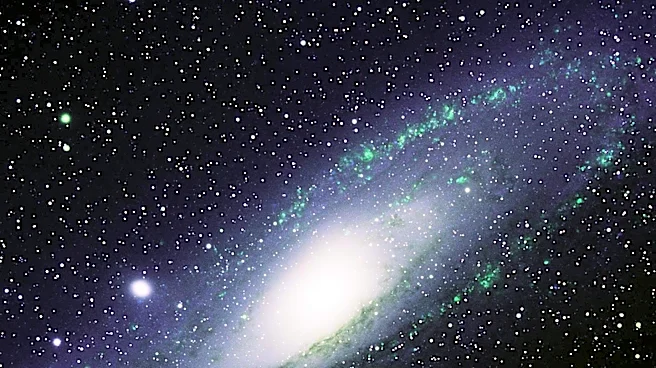
The Andromeda galaxy, visible to the naked eye from Earth as a faint blur, contains hundreds of billions of stars, yet an Earth-like planet orbiting one of them remains far beyond the detection capabilities of any existing telescope. While the collective
light from Andromeda's vast stellar population allows it to be seen from 2.5 million light-years away, isolating a single Earth-Sun analogue within it presents immense observational challenges. According to Space Daily, such a planet would be approximately ten billion times fainter than its host star in visible reflected light. Furthermore, the apparent separation between the planet and its star, even at the widest point of its orbit, would be only about 1.3 microarcseconds. This combination of extreme contrast and minuscule angular separation makes direct imaging impossible with current technology. NASA's Hubble Space Telescope has resolved an estimated 200 million stars in Andromeda, but these are only a fraction of the galaxy's total, and individual Sun-like stars, let alone their planets, are not resolvable.
Why It's Important?
The inability to detect Earth-like planets in Andromeda highlights the profound limitations of current astronomical instrumentation when attempting to resolve individual objects at extragalactic distances. While telescopes like the James Webb Space Telescope (JWST) are revolutionizing exoplanet studies in our cosmic neighborhood, the scale of the universe presents insurmountable hurdles for detecting similar worlds in other galaxies. This underscores the vast difference between observing a galaxy's integrated light and resolving its individual components. The technical challenges—requiring both extraordinary light-gathering power to detect faint planetary photons and extreme precision to suppress the parent star's glare at minute angular separations—are immense. This reality shapes the focus of exoplanet research, directing efforts towards nearby stars where such observations are more feasible, and influencing the design of future observatories like NASA's proposed Habitable Worlds Observatory, which aims to study planets in our local galactic vicinity.
What's Next?
For the foreseeable future, direct imaging of Earth-like planets in galaxies beyond the Milky Way remains an aspiration rather than a near-term possibility. Future advancements in telescope technology would need to overcome the dual challenges of extreme contrast and angular resolution by orders of magnitude. This would likely involve developing entirely new observational techniques, such as space interferometers with baselines spanning hundreds of kilometers, or highly advanced coronagraphs and starshades capable of unprecedented starlight suppression. While direct imaging is out of reach, indirect detection methods, such as gravitational microlensing, could theoretically infer the presence of planets in other galaxies. However, these methods face their own severe limitations in crowded extragalactic fields and do not provide resolved images or atmospheric spectra. Therefore, the focus for exoplanet discovery and characterization will continue to be on stars within our own galaxy, particularly those in the solar neighborhood.
Beyond the Headlines
The discussion of detecting Earth-like planets in Andromeda extends beyond mere technological limitations; it touches upon the philosophical implications of our place in the universe. The sheer scale of the cosmos means that even with advanced technology, much of it remains fundamentally unobservable at a granular level. While we can detect the collective glow of distant galaxies, the individual worlds within them remain hidden, emphasizing the vastness and mystery of the universe. This challenge also highlights the unique position of Earth and our solar system, allowing us to study our own planetary neighborhood in detail. The pursuit of detecting extragalactic exoplanets, even if currently impossible, drives innovation in astronomy and physics, pushing the boundaries of what is observable and reminding us of the profound scientific and engineering challenges involved in exploring the universe beyond our immediate cosmic vicinity.