


What's Happening?
On March 1, 1982, the Soviet Venera 13 probe successfully landed on Venus, enduring the planet's extreme conditions for 127 minutes, significantly surpassing its planned operational life of 32 minutes. During its extended mission, the lander performed
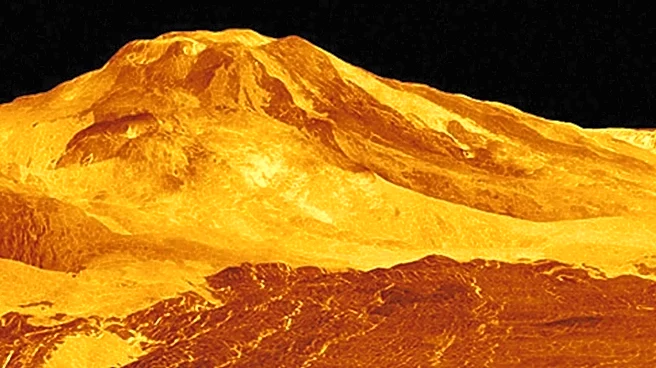
several groundbreaking scientific tasks. It drilled into the Venusian surface, collected a soil sample, and analyzed its elemental composition using an X-ray fluorescence spectrometer. This analysis revealed the presence of potassium-rich alkaline basalt, comparable to terrestrial leucite-bearing basalt. Furthermore, Venera 13 transmitted the first-ever color photographs from the surface of Venus, providing unprecedented visual data of the planet's landscape. The probe's survival for nearly four times its engineering target was a testament to its robust design, which included a titanium pressure vessel protected by insulation and thermal mass to withstand the 465°C heat and approximately 89 times Earth's sea-level atmospheric pressure.
Why It's Important?
The Venera 13 mission marked a pivotal moment in planetary exploration, demonstrating the feasibility of conducting complex scientific operations in extremely hostile environments. Its success provided invaluable data that significantly advanced humanity's understanding of Venus's geology and atmospheric conditions. The first color photographs offered a visual context to previous black-and-white images, revealing the orange-brown sky and surface features like angular slabs and loose material. The soil analysis, identifying potassium-rich alkaline basalt, provided crucial insights into the planet's geological composition, helping scientists compare Venusian geology with Earth's. This mission also set a benchmark for future Venus exploration, highlighting the engineering challenges and the potential for extended operations even under severe conditions. The data collected by Venera 13 continues to inform and inspire new approaches to designing probes capable of withstanding extreme planetary environments, influencing the development of high-temperature electronics and mechanical rovers for future missions.
What's Next?
While no spacecraft has transmitted from the surface of Venus since 1985, the engineering lessons from Venera 13 remain highly relevant for future Venus missions. Engineers are exploring new technologies, such as silicon-carbide electronics, which can tolerate temperatures that would destroy conventional silicon circuits, and mechanical systems designed to take over functions typically assigned to computers. Future missions may also focus on short-lived descent probes to target specific chemical analyses without attempting long-term surface operations. The insights gained from Venera 13's design, particularly its ability to arrive cold, descend quickly, protect its interior, and sequence science automatically, continue to guide the development of new probes. Although a broad ground-truth network like that on Mars is still lacking for Venus, ongoing orbital radar missions and planned future landers aim to build upon the foundational data provided by Venera 13 to further unravel the mysteries of Earth's sister planet.
Beyond the Headlines
The Venera 13 mission's unexpected longevity and scientific achievements underscore the critical role of robust engineering and meticulous planning in space exploration. The probe's ability to function for 127 minutes, far exceeding its 32-minute design life, highlights the often-conservative estimates in mission planning and the potential for hardware to outperform expectations. This success also illustrates the challenges of remote troubleshooting in space, as the probe had to execute its complex drilling and analysis sequence autonomously without real-time intervention from Earth. The mission's legacy extends beyond scientific data, influencing the philosophical approach to designing spacecraft for extreme environments—prioritizing resilience and self-sufficiency. The detailed reconstruction of color images from filtered scans also points to the interpretive nature of scientific visualization, where raw data is processed to create understandable representations. Venera 13's enduring record on Venus continues to inspire discussions about the limits of technology and the potential for discovery in the most inhospitable corners of our solar system.