

What's Happening?
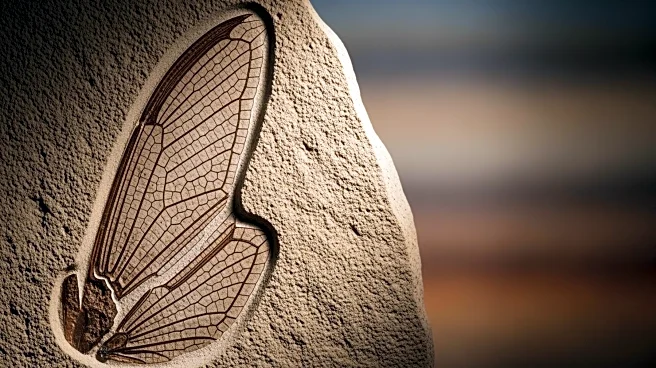
A new study led by Edward Snelling from the University of Pretoria challenges the long-held belief that high atmospheric oxygen levels 300 million years ago were responsible for the gigantism of insects like griffinflies. Using high-power electron microscopy,
researchers found that the space occupied by tracheoles in insect flight muscles is minimal, suggesting that oxygen levels did not constrain insect size. This refutes the theory that giant insects required higher oxygen concentrations to support their flight muscles. The study, published in Nature, suggests that other factors, such as predation or biomechanical limits, may have influenced insect size.
Why It's Important?
This research provides new insights into the evolutionary history of insects and the factors that influenced their size. By debunking the oxygen-size theory, the study opens up new avenues for understanding the ecological and evolutionary pressures that shaped insect gigantism. The findings have implications for the study of past and present ecosystems, as they challenge assumptions about the relationship between atmospheric conditions and biological traits. This research also highlights the importance of using advanced microscopy techniques to explore evolutionary questions.
Beyond the Headlines
The study's findings prompt a reevaluation of the factors that contributed to insect gigantism, suggesting that researchers should explore alternative explanations such as ecological interactions and biomechanical constraints. This could lead to a broader understanding of how environmental and biological factors interact to shape the evolution of species. The research also underscores the complexity of evolutionary processes and the need for interdisciplinary approaches to unravel them.