


What's Happening?
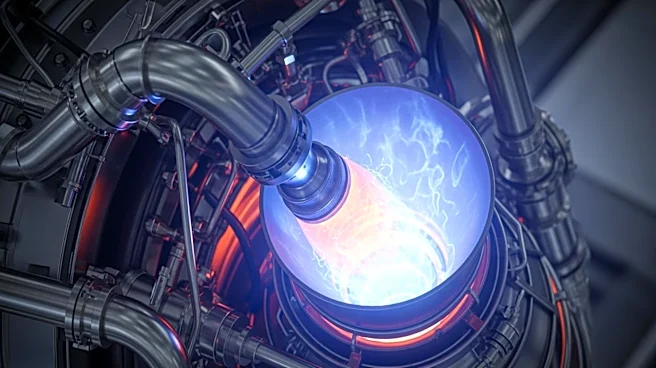
Mega Engine Technology, a commercial startup based in Xi'an, China, has announced a significant achievement in the development of high-pressure oxygen-rich staged-combustion kerolox engines. The company reported that its engine, named Chi, has accumulated
1,000 seconds of run time at rated conditions during its test campaign. This milestone is notable as such endurance figures have traditionally been associated with engines developed within China's state propulsion houses. The Chi engine demonstrated rapid startup, stable operation, and intact hardware upon post-test inspection. Mega Engine Technology aims to provide Chinese commercial launchers with access to staged-combustion performance, which has been largely confined to state institutions. The company plans to unveil a second engine, Yan, later in 2026, intended for heavy-lift applications.
Why It's Important?
The development of high-pressure oxygen-rich staged-combustion engines by Mega Engine Technology represents a significant advancement for China's commercial space sector. This technology offers higher chamber pressure and better specific impulse compared to open-cycle engines, which are more common among commercial startups. The ability to produce such engines outside of state-controlled institutions could enhance the capabilities of Chinese commercial launch companies, enabling them to compete more effectively in the global space industry. The achievement aligns with China's broader strategy of civil-military fusion, which aims to integrate state-developed technologies into private ventures, thereby accelerating technological advancements and reducing the time required to bring new capabilities to market.
What's Next?
Mega Engine Technology plans to introduce a second engine, Yan, later in 2026, which is designed for heavy-lift applications. If successful, this engine would further expand the capabilities of China's commercial space sector, providing a domestically produced, reusable, high-performance kerolox engine. The company's progress is likely to attract interest from commercial launch companies seeking to fulfill contracts for China's ambitious megaconstellation programs, which aim to deploy tens of thousands of satellites. The success of Mega Engine Technology could also prompt other private companies to pursue similar technological advancements, potentially reshaping the competitive landscape of the global space industry.
Beyond the Headlines
The emergence of Mega Engine Technology as a credible player in the development of high-pressure oxygen-rich staged-combustion engines highlights the effectiveness of China's civil-military fusion policy. This approach facilitates the transfer of expertise and technology from state institutions to private companies, accelerating innovation and reducing the time required to bring new products to market. The company's rapid progress in developing complex propulsion systems suggests that China's commercial space sector is poised to become a more significant player in the global industry. This development may also influence other countries to reconsider their approaches to integrating state and private sector capabilities in strategic industries.