





What's Happening?
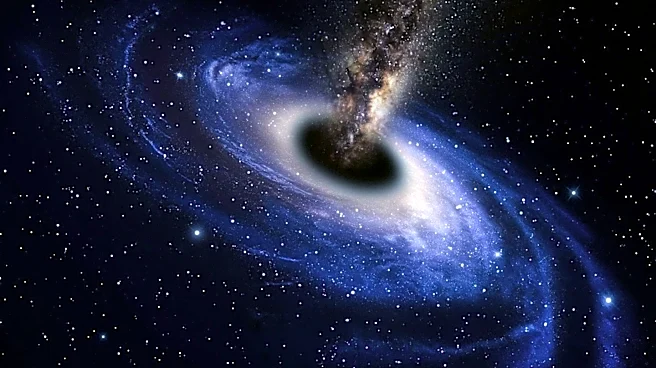
A recent theoretical study, published on the arXiv preprint server by physicists from Sorbonne University, the University of Southern Denmark, and the University of Naples Federico II, investigates the conditions under which a black hole might split into
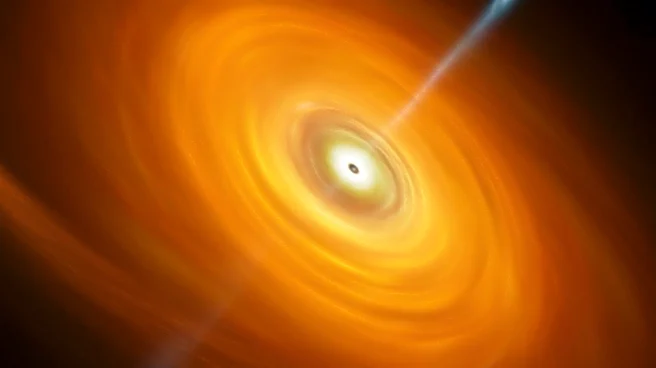
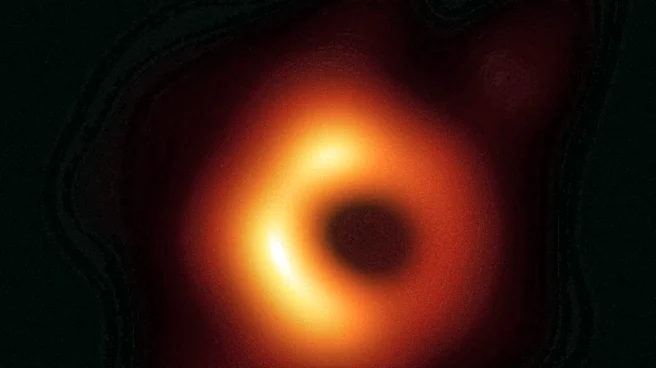
two. While classical general relativity typically describes black holes coalescing, this research explores the kinematic, thermodynamic, and topological boundaries of black hole fission. The study suggests that a rapidly spinning Kerr black hole, almost at its physical limit, could theoretically split into two smaller, less rapidly spinning fragments. This scenario is particularly nuanced because higher spin rates in Kerr black holes correspond to smaller event horizon areas and lower intrinsic entropy, potentially creating a thermodynamic loophole for fragmentation. However, the researchers emphasize that energy and angular-momentum conservation, along with the requirement for fragments to escape rather than re-merge, severely restrict these configurations, making such an event highly improbable under standard four-dimensional physics.
Why It's Important?
This theoretical exploration is significant for advancing our understanding of the fundamental laws governing black holes and the universe. If black hole fragmentation were possible, it could offer an alternative explanation for the formation of certain black hole masses not easily accounted for by standard astrophysical processes. The study also delves into more exotic scenarios, such as those involving additional spatial dimensions or modifications to general relativity, which could have profound implications for theoretical physics. Understanding these extreme cosmic phenomena helps refine our models of gravity and spacetime, potentially leading to new insights into the early universe and the nature of matter and energy at their most fundamental levels. The research highlights the ongoing quest to push the boundaries of current physical theories and explore possibilities beyond established paradigms.
What's Next?
The authors of the study emphasize that while their research identifies thermodynamically favorable configurations for black hole fragmentation, it does not prove that such a process can dynamically occur. Future work will require detailed dynamical analyses or simulations to establish whether these fragmentation processes are actually possible. The study suggests that if fragmentation can occur in any of the proposed settings, it could lead to observable gravitational-wave and Hawking-radiation signatures, particularly in models that extend beyond standard general relativity. These potential observational cues could guide future astronomical research and provide empirical evidence to test these theoretical predictions. Continued research in this area will likely involve further theoretical modeling and, eventually, the search for observational data that could support or refute these complex hypotheses.
Beyond the Headlines
The concept of a black hole splitting challenges some of the most fundamental tenets of classical general relativity, particularly the Bekenstein–Hawking area theorem and Penrose’s non-bifurcation theorem. These theorems generally rule out entropy-decreasing fragmentation and topological changes in event horizons, respectively. The study's exploration of rapidly rotating Kerr black holes and scenarios beyond standard four-dimensional physics, such as higher-dimensional general relativity or modified gravity models, opens up avenues for rethinking the stability and evolution of black holes. It touches upon the cosmic censorship hypothesis, which posits that singularities are always hidden behind event horizons, and how fragmentation might challenge this. The research also implicitly raises questions about the limits of our current understanding of spacetime and gravity, suggesting that there may be physical phenomena at extreme scales that require a more comprehensive theoretical framework than what is currently available.