






What's Happening?
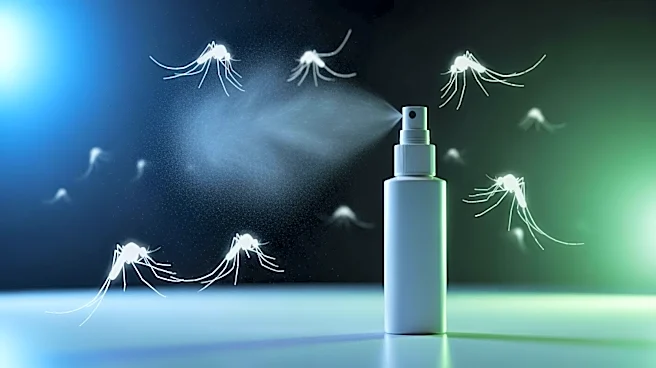
Recent research published in the Journal of Experimental Biology suggests that the commonly used insect repellent Deet may attract mosquitoes rather than repel them. The study found that nearly 60% of mosquitoes that had previously fed on blood while
exposed to Deet attempted to bite a Deet-dipped hand in subsequent encounters. This indicates that mosquitoes can learn to associate the strong smell of Deet with a food source, leading to attraction. Dr. Nina Stanczyk from ETH Zürich University noted that mosquitoes have impressive learning abilities, which allow them to associate the repellent's smell with food. The study challenges previous assumptions about Deet's effectiveness, suggesting that its impact can be modified by experience.
Why It's Important?
The findings of this study could have significant implications for public health, particularly in regions where mosquito-borne diseases are prevalent. If Deet, a widely used repellent, is less effective than previously thought, it may necessitate the development of new strategies for mosquito control. This is especially critical given the rising incidence of diseases like dengue in non-tropical regions. The study highlights the need for further research into mosquito behavior and the development of more effective repellents. Public health policies may need to adapt to these findings to better protect communities from mosquito-borne illnesses.
What's Next?
Further research is needed to understand the long-term implications of these findings and to explore alternative mosquito repellent strategies. Scientists may investigate other compounds or methods that do not trigger associative learning in mosquitoes. Public health officials might consider revising guidelines on repellent use and explore integrated pest management approaches. Additionally, there could be increased focus on educating the public about effective mosquito prevention techniques beyond chemical repellents.