





What's Happening?
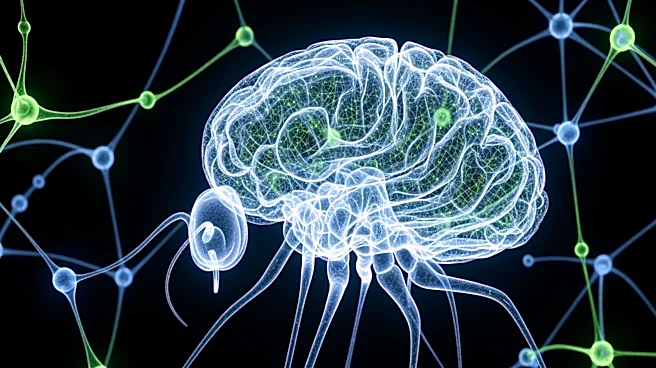
A collaborative research team from Harvard Medical School and Princeton University has successfully mapped the complete neural connections, or connectome, of an adult fruit fly. This groundbreaking achievement provides a comprehensive view of how neurons
in the central nervous system are interconnected, offering new insights into the coordination of brain and body functions. The connectome includes the fruit fly's brain and its spinal cord equivalent, known as the nerve cord. This detailed mapping allows scientists to study how local neural circuits in specific body parts, rather than a central brain command, direct behaviors such as walking and flying. The connectome is now available online, providing a valuable resource for further neuroscience research. The study, published in Nature, was supported by U.S. federal funding, including the BRAIN Initiative and the National Institutes of Health.
Why It's Important?
The completion of the fruit fly connectome marks a significant advancement in neuroscience, offering a new tool to explore how neural circuits control behavior. This research could lead to a deeper understanding of nervous systems across species, including humans. By revealing that motor control is largely managed by local circuits, the study challenges the traditional view of the brain as a centralized controller. This insight could influence future research in both biological and artificial intelligence fields, as the connectome provides a model for understanding complex behaviors. The availability of this detailed neural map may also inspire new hypotheses and experimental approaches in neuroscience, potentially leading to breakthroughs in understanding brain function and behavior.
What's Next?
Researchers plan to expand the connectome by incorporating additional data, such as neuropeptides, which are crucial for neuron communication. The connectome's insights into distributed neural control could be explored in other species, potentially revealing universal principles of nervous system organization. The study's findings may also inform the development of artificial intelligence systems, as the biological data could guide the design of more sophisticated AI agents. Ongoing research will likely focus on applying these insights to more complex organisms, with the potential to revolutionize our understanding of neural networks and their applications in technology and medicine.
Beyond the Headlines
The fruit fly connectome could have far-reaching implications beyond immediate scientific research. It may influence ethical discussions about the use of AI and robotics, as understanding biological neural networks could lead to more advanced and autonomous systems. Additionally, the study highlights the importance of open collaborative science, as the connectome is freely available for researchers worldwide. This approach could set a precedent for future large-scale scientific projects, promoting transparency and collaboration in the scientific community.