

What's Happening?
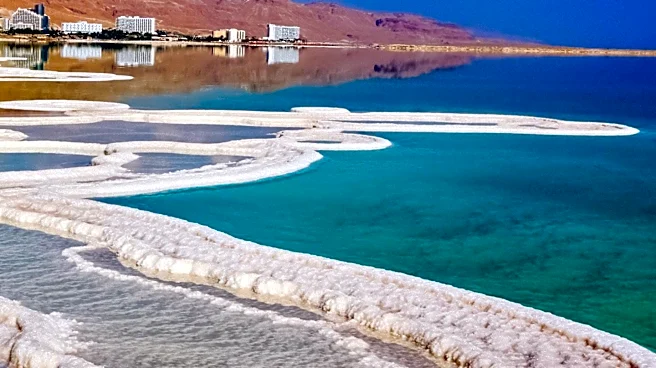
The Dead Sea is accumulating approximately 10 centimeters of salt each year, a phenomenon attributed to a process known as 'salt fingers.' This mechanism, first proposed by researchers in 2016 and subsequently supported by a 2019 study, involves warmer,
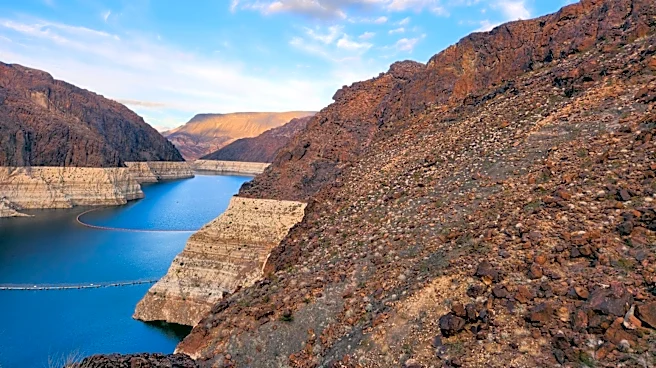
salt-laden surface water mixing with cooler water at deeper levels. This interaction triggers the crystallization of salt, causing the salt particles to sink and accumulate on the lakebed. The increasing salinity of the Dead Sea is also linked to diversions of freshwater sources, which contribute to the overall concentration of salt in the body of water. This ongoing process not only explains the current geological changes in the Dead Sea but also offers insights into the formation of ancient salt deposits found in other geological contexts.
Why It's Important?
The continuous accumulation of salt in the Dead Sea has significant environmental and scientific implications. Understanding the 'salt fingers' mechanism provides crucial insights into the dynamics of hypersaline environments and the complex interplay between water temperature, salinity, and mineral deposition. This research can inform studies on similar geological formations globally, helping scientists to better comprehend both contemporary and historical geological processes. The increasing salinity, exacerbated by freshwater diversions, highlights the ecological fragility of unique natural environments and the impact of human activities on these ecosystems. Furthermore, the study of salt crystallization processes in extreme environments like the Dead Sea can have broader applications in materials science and industrial processes that involve crystallization.
What's Next?
Future research will likely focus on further refining the understanding of the 'salt fingers' mechanism, including the precise conditions that initiate and sustain the crystallization process. Scientists may also investigate the long-term effects of this salt accumulation on the Dead Sea's ecosystem, including its unique microbial life and the overall chemical composition of the water. Monitoring the rate of salt deposition and its correlation with freshwater inflow reductions will be critical for predicting future changes in the Dead Sea's volume and salinity. Additionally, the insights gained from this research could be applied to other salt lakes and hypersaline environments worldwide, contributing to a more comprehensive understanding of global geological and hydrological systems.
Beyond the Headlines
The phenomenon of salt accumulation in the Dead Sea extends beyond immediate geological observations, touching upon broader themes of environmental change and resource management. The diversion of freshwater sources, a contributing factor to increased salinity, underscores the global challenge of water scarcity and its impact on natural landscapes. This situation prompts deeper consideration of sustainable water management practices and the need for international cooperation in preserving shared natural resources. The Dead Sea, a unique natural wonder, serves as a stark reminder of how human intervention can alter delicate ecological balances, leading to long-term geological and environmental transformations. The study also highlights the continuous evolution of Earth's geological features, offering a real-time example of processes that have shaped our planet over millennia.