




What's Happening?
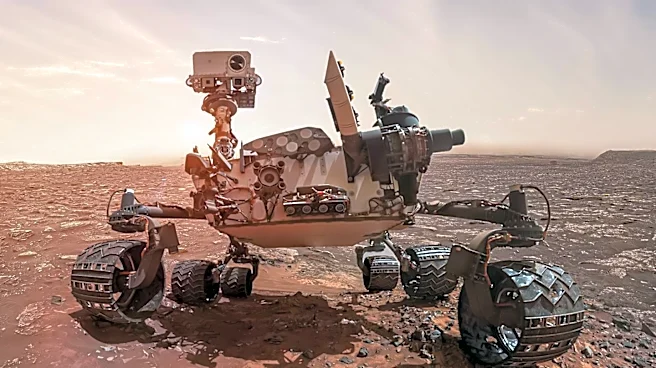
NASA's Curiosity rover has captured a striking image of dawn on the Martian surface, showcasing sunlight illuminating jagged crags formed billions of years ago. The image was taken by the rover's Mastcam camera approximately an hour after sunrise, revealing
wind-carved cliffs in the distance. Since its landing in Gale Crater in 2012, Curiosity has been ascending Mount Sharp, a 3-mile-tall mountain. Planetary scientist Ashwin Vasavada of NASA’s Jet Propulsion Laboratory explained that the bright, craggy peaks are a distinct rock layer, believed to be ancient wind-blown sediment that hardened into rock and was subsequently carved into ridges called yardangs. This yardang layer likely formed around 3 billion years ago and spans about 10 miles across Mount Sharp's northwestern reaches. The rover has climbed over 0.6 miles (1 km) in elevation, a record for Mars. Curiosity continues its mission to study Mars' geology and climate, investigating past conditions that might have supported microbial life. It is one of two NASA rovers currently operating on Mars, with the Perseverance rover exploring Jezero Crater.
Why It's Important?
This new image from the Curiosity rover provides valuable insights into Mars' geological history and atmospheric conditions. The detailed view of the yardang layer helps scientists understand the planet's past sedimentary processes and erosion patterns, offering clues about Mars' ancient environment when it was potentially warmer and wetter. By studying these layers, researchers can reconstruct the planet's climatic evolution and assess its habitability over billions of years. The ongoing ascent of Mount Sharp allows Curiosity to analyze different geological strata, each representing a distinct period in Martian history. This data is crucial for understanding how Mars transformed from a potentially life-supporting planet to its current cold, desolate state. The mission's findings contribute to the broader scientific goal of determining the potential for extraterrestrial life and informing future human missions to Mars, by providing critical information about the planet's surface and environmental challenges.
What's Next?
NASA anticipates that the Curiosity rover will reach the yardang layer in 2027 or 2028. Upon arrival, the rover will utilize its instruments to conduct a detailed scrutiny of the geology of this unique rock formation. This upcoming phase of the mission is expected to yield more specific data on the composition and formation processes of the yardangs, further enhancing our understanding of Mars' geological timeline. The continued exploration of Mount Sharp will allow scientists to analyze successive layers of rock, each offering a window into different epochs of Martian history. The data collected will be integrated with observations from other Mars missions, including the Perseverance rover, to build a comprehensive picture of the planet's past and present conditions. Future plans also involve using this accumulated knowledge to refine models of planetary evolution and to prepare for potential human exploration, by identifying areas of scientific interest and potential resources.
Beyond the Headlines
The Curiosity rover's ongoing mission and its latest imagery transcend mere scientific data collection; they offer a profound perspective on humanity's place in the cosmos and our relentless pursuit of knowledge. The 'otherworldly' scenes captured by Curiosity, as described by planetary scientist Ashwin Vasavada, evoke a sense of both familiarity and alienness, prompting reflection on the unique conditions that fostered life on Earth. The ability to observe such ancient geological formations on another planet underscores the vastness of geological time and the dynamic processes that shape planetary bodies. This continuous stream of data from Mars not only advances astrobiology and planetary science but also inspires public interest in space exploration, fostering a deeper appreciation for scientific inquiry and technological innovation. The mission serves as a testament to human ingenuity, pushing the boundaries of what is possible in robotic exploration and laying foundational knowledge for future interstellar endeavors.