


What's Happening?
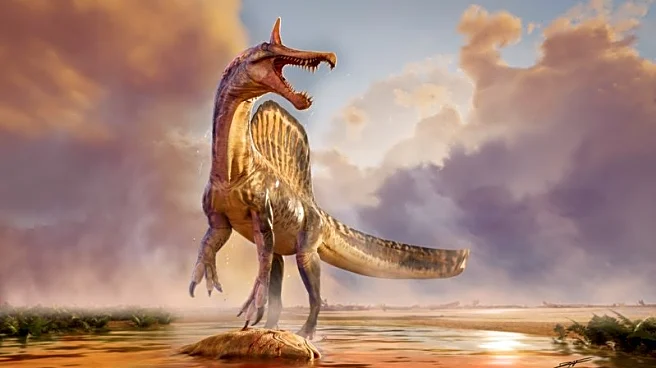
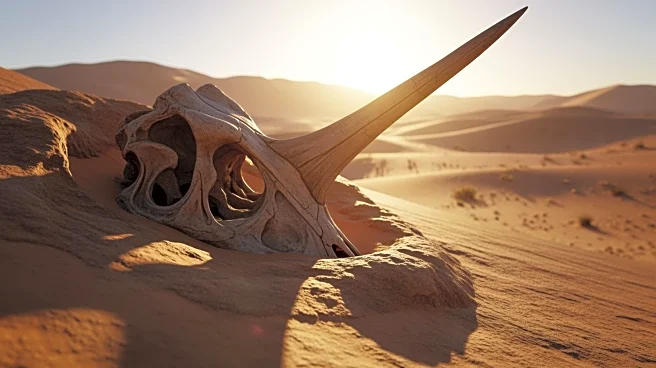
A team of fossil hunters has discovered a new species of Spinosaurus, dubbed Spinosaurus mirabilis, in Niger's Sahara Desert. This dinosaur, described as a 'dinosaur from hell,' features a distinctive 20-inch scimitar-like cranial crest. The discovery
was made by a team led by Paul Sereno from the University of Chicago. Spinosaurus mirabilis lived approximately 95 million years ago and was a formidable predator with a sail-finned back and interlocking teeth for catching fish. The fossils were found far inland, challenging previous theories that Spinosaurus was a fully aquatic predator. Instead, it likely lived in forested areas with rivers, using its unique adaptations to hunt in shallow waters.
Why It's Important?
The discovery of Spinosaurus mirabilis offers new insights into the ecological diversity and adaptations of spinosaurid dinosaurs. The inland location of the fossils suggests that these dinosaurs were not exclusively aquatic, prompting a reevaluation of their ecological roles and habitats. This finding challenges long-standing theories about the lifestyle of Spinosaurus and highlights the complexity of dinosaur evolution. The unique features of Spinosaurus mirabilis, such as its cranial crest and interlocking teeth, provide valuable information about the evolutionary pressures that shaped these adaptations. This discovery could lead to a broader understanding of dinosaur biodiversity and their interactions with their environment during the Cretaceous period.
What's Next?
Further research is expected to focus on additional excavations in the Sahara to uncover more fossils and gain a deeper understanding of the ecosystem in which Spinosaurus mirabilis lived. Comparative studies with other spinosaurid fossils will be crucial to refine theories about their evolutionary history and ecological roles. The findings may also prompt a reexamination of existing spinosaurid fossils in museum collections, potentially leading to new discoveries about their morphology and behavior. Researchers hope to gain more insights into the habitat and life of Spinosaurus mirabilis during the Cretaceous epoch.