





What's Happening?
Researchers from the U.S. Food and Drug Administration (FDA) have created a new hydrologic modeling framework designed to identify leafy greens farms at risk of contamination from upstream livestock operations during rainfall events. This model, detailed
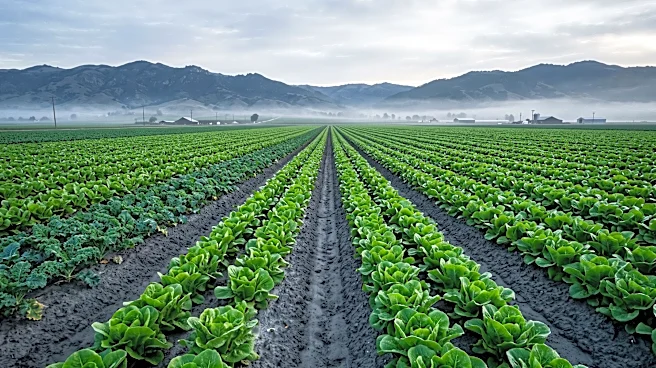
in a study accepted for publication in the Journal of Food Protection, focuses on California’s Salinas Valley, a significant region for leafy greens production that has been linked to multiple outbreaks of Shiga toxin-producing Escherichia coli (STEC). The framework combines rainfall-derived runoff estimates with mapped surface-water drainage networks to connect livestock operations with downstream produce farms. It incorporates characteristics such as estimated cattle capacity and the distance runoff travels along drainage pathways. The study analyzed 48 rainfall events between 2018 and 2021 across a 1,239-square-kilometer area of the Salinas Valley, identifying 1,818 hydrologic connections between 58 livestock pastures and 277 downstream farms. The findings indicate that hydrologic connectivity, rather than mere geographic proximity, is the primary determinant of a farm's exposure to runoff.
Why It's Important?
This FDA-developed model is crucial for enhancing food safety within the U.S., particularly for leafy greens, which have been a source of foodborne illness outbreaks. By providing a tool to predict potential contamination pathways from livestock runoff, the model can help prevent future outbreaks of pathogens like STEC. This is significant for public health, as it allows for more targeted environmental monitoring and mitigation efforts, potentially reducing the incidence of foodborne diseases. For the agricultural industry, especially leafy greens producers, this model offers a proactive approach to managing risks, which could lead to improved product safety, reduced recalls, and enhanced consumer confidence. It also highlights the need for a broader understanding of contamination beyond immediate farm boundaries, emphasizing landscape-scale hydrologic connectivity. The ability to identify high-risk areas can guide resource allocation for interventions, making food safety measures more efficient and effective.
What's Next?
The FDA's hydrologic model is intended as a screening tool to complement existing produce safety assessments. It does not directly estimate pathogen presence or concentrations but rather characterizes the relative hydrologic influence of upstream livestock sources on downstream farms. Future applications include prioritizing water and sediment sampling during and after rainfall events, identifying upstream areas for further investigation, and evaluating opportunities for drainage management, vegetated buffers, and other runoff mitigation measures. The researchers acknowledge that the framework does not account for all factors, such as groundwater movement, flooding, field-scale drainage infrastructure, or site-specific runoff controls. Therefore, ongoing research and integration with other data sources will be necessary to refine the model and broaden its applicability. Collaboration between regulators, researchers, and industry stakeholders will be key to implementing these findings and developing comprehensive strategies to safeguard produce from contamination.
Beyond the Headlines
The development of this model underscores a broader shift towards data-driven and predictive approaches in food safety. It moves beyond reactive responses to outbreaks by enabling proactive identification of risks. This has implications for regulatory policy, potentially leading to new guidelines or requirements for farms located within hydrologically connected areas to livestock operations. Ethically, it raises questions about shared responsibility for environmental management across agricultural landscapes, as the actions of one farm can impact others downstream. Culturally, it may foster greater collaboration among different agricultural sectors to address common environmental challenges. In the long term, this approach could lead to more resilient food systems, better protecting public health while supporting sustainable agricultural practices. The model also serves as a template for addressing similar environmental contamination risks in other agricultural regions and for different types of produce.