




What's Happening?
Students from Stockbridge Junior Senior High School are actively modifying NASA's STELLA-Q2 platform to monitor coral health in Punta Cana, Dominican Republic. Under the guidance of their teacher, Mr. Richards, the students have integrated an Arducam
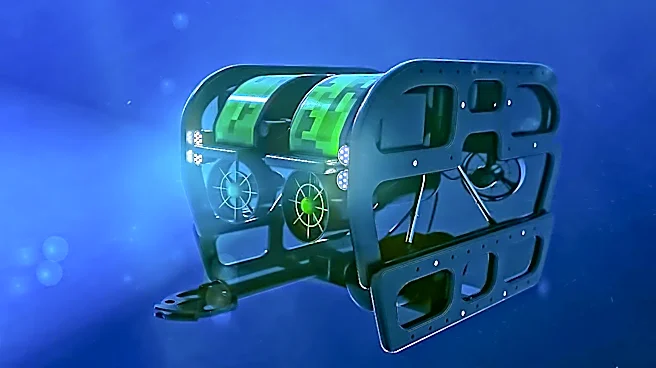
camera module with the STELLA-Q2 sensor. This modification allows them to capture visual photographs alongside spectral readings, providing crucial context to the data collected. Previously, students found it difficult to interpret spectral data without knowing what the sensor was pointed at. The camera integration helps standardize measurements and makes the data more understandable for both scientists and the public. The team is also developing a 3D-printed waterproof housing for the device, with the ultimate goal of mounting it on an underwater robot (ROV) to conduct long-term coral health assessments. Their work aims to provide early warning signs of coral degradation, contributing to conservation efforts in areas like Punta Cana, where only 1% of original coral remains.
Why It's Important?
This student-led initiative has significant implications for both environmental science and STEM education in the U.S. By actively engaging with NASA's open-source technology, these high school students are gaining real-world engineering and scientific experience, moving beyond theoretical classroom learning. Their work directly contributes to critical environmental conservation efforts, specifically in monitoring and protecting coral reefs, which are vital ecosystems facing severe threats globally. This project demonstrates how accessible technology and student innovation can be leveraged to address complex scientific challenges. For the U.S., it highlights the potential of integrating advanced scientific tools into secondary education, fostering a new generation of engineers and scientists. It also showcases a model for citizen science, where local communities and educational institutions can play a direct role in global environmental monitoring and data collection, potentially influencing broader scientific research and policy on marine conservation.
What's Next?
The immediate next step for the Stockbridge High School team is to deploy their modified STELLA-Q2 sensor in a lab in the Dominican Republic for initial testing. Following this, they plan to further refine the waterproof housing and integrate the device with an underwater robot for broader field deployment. The team aims to collaborate with the Marine Innovation Center in Punta Cana, allowing local students to replicate their work and expand data collection. Future developments include incorporating a LiDAR for more standardized distance measurements and potentially integrating artificial intelligence for faster data processing and analysis. The project also emphasizes continuous improvement in team professionalism, public speaking, and social media outreach, indicating a commitment to effective scientific communication. If successful, this project could serve as a blueprint for other schools and communities to engage in similar environmental monitoring initiatives using open-source NASA technology.
Beyond the Headlines
Beyond the immediate scientific and educational achievements, this project touches upon deeper themes of global collaboration, technological accessibility, and the democratization of science. The use of open-source NASA technology empowers students and communities worldwide to participate in scientific research, breaking down traditional barriers to entry. This fosters a sense of global citizenship and shared responsibility for environmental stewardship. Ethically, the project highlights the importance of proactive conservation efforts and the role of technology in providing early warnings for ecological crises. It also underscores the value of experiential learning, where students learn not just facts, but also problem-solving, critical thinking, and teamwork in a real-world context. Culturally, it represents a shift towards more hands-on, interdisciplinary education that prepares students for complex challenges, moving beyond traditional classroom settings to engage with pressing global issues like climate change and biodiversity loss.