

What's Happening?
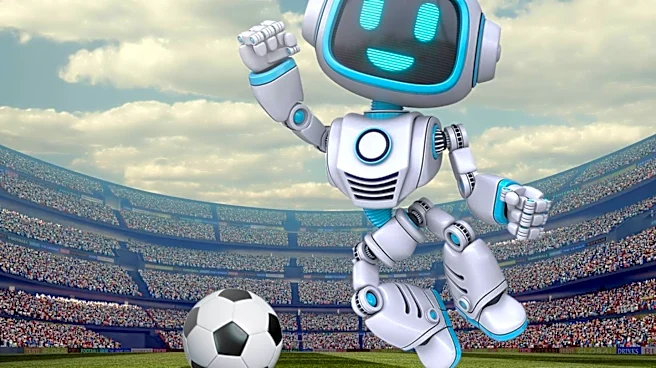
Researchers from Tsinghua University and ByteDance have developed a unified reinforcement learning-based controller that enables humanoid robots to learn vision-driven reactive soccer skills. This innovation allows robots to coordinate agile locomotion
with visual perception in dynamic environments. The robots are trained in simulation to acquire soccer behaviors, with Adversarial Motion Priors guiding policy learning towards natural motion patterns. The system introduces an encoder-decoder architecture and a virtual perception system to model key characteristics of onboard vision, exposing the policy to perceptual noise and detection failures during training. This approach has resulted in a controller that produces coordinated soccer behaviors using only onboard vision, achieving significant improvements in performance metrics.
Why It's Important?
The development of vision-driven reactive soccer skills for humanoid robots represents a significant advancement in the field of embodied intelligence. By integrating perceptual uncertainty directly into policy learning, the researchers have created a system that can adapt to real-world conditions, enhancing the robots' ability to perform complex tasks. This progress could have far-reaching implications for the deployment of humanoid robots in various applications, from entertainment and sports to industrial and service sectors. The ability to operate effectively in dynamic environments could make humanoid robots more viable for tasks that require a high degree of autonomy and adaptability.
What's Next?
The successful demonstration of these capabilities in real RoboCup competitions suggests that further testing and refinement could lead to broader applications of this technology. Future developments may focus on enhancing the robustness and versatility of humanoid robots, potentially leading to their integration into more complex and varied environments. As these technologies mature, they may also prompt discussions around the ethical and societal implications of humanoid robots in public and private spaces.