
What's Happening?
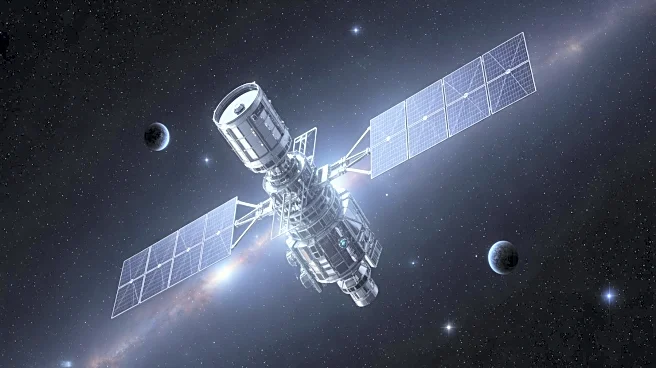
NASA has successfully launched a new telescope named Pandora into space aboard a SpaceX Falcon 9 rocket. The telescope, now in Sun-synchronous orbit, is designed to study exoplanets, which are planets orbiting
stars outside our solar system. Unlike the larger James Webb Space Telescope, Pandora is equipped with a 17-inch lens specifically tailored to observe and analyze the atmospheres of these distant worlds. Over the course of its one-year mission, Pandora is expected to study at least 20 exoplanets and their host stars. This mission aims to overcome previous observational challenges by providing extended temporal coverage, which will help astronomers better understand the atmospheric composition of exoplanets and search for signs of life.
Why It's Important?
The deployment of Pandora represents a significant advancement in the field of exoplanet research. By focusing on the atmospheres of exoplanets, Pandora can provide critical data that may reveal the presence of water vapor, hydrogen, and other elements essential for life. This mission could potentially identify habitable conditions on planets beyond our solar system, expanding our understanding of the universe and the possibility of life elsewhere. Additionally, Pandora's ability to observe stars and their planets simultaneously will help refine data accuracy, reducing noise from stellar activity that has previously hindered exoplanet studies.
What's Next?
Pandora's mission will involve revisiting each target star multiple times to gather comprehensive data. This approach will allow scientists to monitor changes in the stars and their planets over time, providing insights into the dynamic processes at play. The findings from Pandora could influence future telescope designs and missions, as well as guide the search for life beyond Earth. The scientific community will be closely watching the results of Pandora's observations, which could lead to groundbreaking discoveries in the field of astronomy.