




What's Happening?
The U.S. House of Representatives has passed the Ratepayer Protection Act (RPA) with broad bipartisan support, voting 417-3. This bill aims to protect communities from increased electricity and grid infrastructure costs linked to the expansion of data
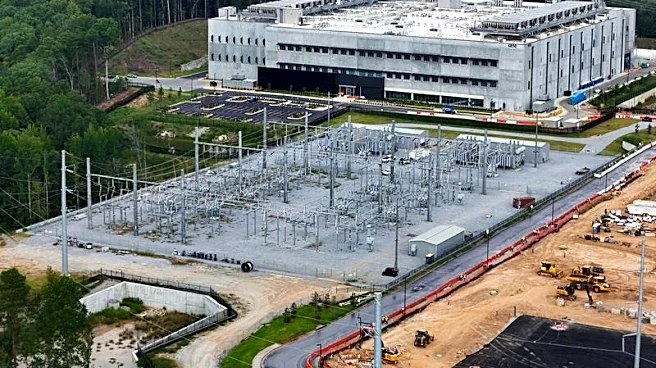
centers. The legislation amends the Public Utility Regulatory Policies Act (PURPA) to establish a federal standard requiring large data centers, those consuming 100 megawatts or more, to bear the full additional costs of generation, transmission, and distribution upgrades built to serve them. Additionally, companies would need to provide financial assurances to prevent communities from being burdened with costs if a project is canceled or relocated. The bill's sponsor, Rep. Gabe Evans, R-Colo., emphasized that it ensures American families, farmers, and small businesses are not forced to cover the energy demands of these developments. Rep. Kathy Castor, D-Fla., a Democratic co-sponsor, highlighted that ratepayers should not subsidize the growing energy demands of wealthy corporations, particularly AI data centers, which contribute to skyrocketing electric bills.
Why It's Important?
This legislation is significant as it addresses a growing concern over rising utility costs, which have increased by 38% since 2020, partly driven by the rapid expansion of data centers and artificial intelligence. The bill seeks to prevent these costs from being passed on to residential ratepayers, thereby impacting household budgets already strained by inflation. Housing, groceries, and utilities are major expenses for many Americans, and the affordability of these essentials is a key factor influencing voter sentiment, especially as the 2026 midterm elections approach. By requiring data centers to pay their own way for energy infrastructure, the bill aims to alleviate financial pressure on consumers and local communities. This move reflects a broader political scramble by both Democrats and Republicans to offer solutions for affordability and energy concerns, with candidates increasingly linking data center expansion to the issue of rising costs for everyday Americans.
What's Next?
Following its passage in the House, the Ratepayer Protection Act will now move to the Senate, where its future remains uncertain. The bill's fate in the Senate will determine whether this federal standard for data center energy cost allocation becomes law. If enacted, states would be required to consider this new federal standard, potentially leading to significant changes in how energy infrastructure for large data centers is financed and developed across the country. Stakeholders, including utility companies, data center operators, and consumer advocacy groups, will likely monitor its progress closely. The debate surrounding data centers and their energy consumption is expected to continue, particularly as the demand for AI-driven technologies grows, prompting further discussions on regulatory guidelines and sustainable energy solutions.
Beyond the Headlines
The passage of this bill highlights a deeper tension between technological advancement and its societal costs. While the expansion of AI and data centers is seen as crucial for economic growth and global competitiveness, particularly against nations like China, the legislation underscores the ethical and economic imperative to ensure that the benefits of such innovation do not disproportionately burden ordinary citizens. It raises questions about the long-term sustainability of energy grids under increasing demand from high-consumption industries and the need for equitable cost distribution. This development could set a precedent for how other energy-intensive industries are regulated in the future, potentially influencing investment decisions and the geographical distribution of data center development. It also reflects a growing public and political awareness of the environmental and financial impacts of large-scale technological infrastructure.