



What's Happening?
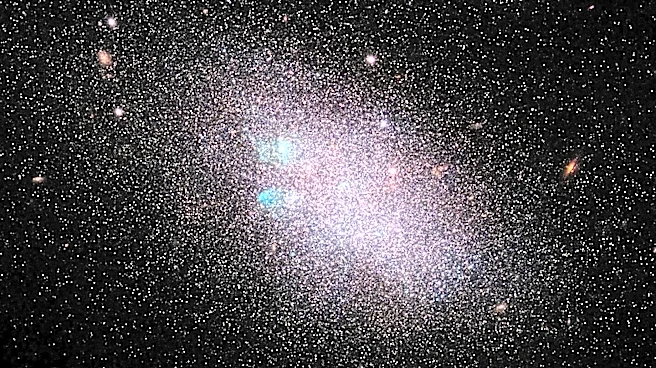
Astronomers have identified nearly 50 previously undiscovered 'ghost' dwarf galaxies, located up to 100 million light-years away. This discovery was made through a meticulous visual inspection of images from the Very Large Telescope's (VLT) VST SMASH
survey, rather than relying solely on algorithms. The team, led by Crescenzo Tortora of the Italian National Institute for Astrophysics (INAF), masked light from foreground stars to reveal these faint galaxies. Of the 47 dwarf galaxies observed, only four had been previously known. These newly found dwarf galaxies exhibit various shapes, including spheroidals, ellipticals, irregulars, and some with internal structures suggesting they are dwarf spirals. Their masses range from one million to one billion times the mass of the sun. This finding is significant for addressing long-standing puzzles in cosmology, such as the 'missing satellite galaxies' problem, where the number of dwarf satellite galaxies orbiting the Milky Way is fewer than predicted by the standard cosmological model.
Why It's Important?
The discovery of these numerous dwarf galaxies is crucial for understanding the universe's structure and the role of dark matter. Dwarf galaxies are considered key to solving some of the major puzzles of the cosmological model, particularly how mysterious dark matter shapes and molds the entire universe. For decades, astronomers have grappled with the 'missing satellite galaxies' problem, where observations of the Milky Way's surroundings show fewer dwarf satellites than theoretical predictions. This new data provides a larger sample of dwarf galaxies, which can help refine existing models and potentially resolve discrepancies. By studying these 'islands of nearly invisible stars,' scientists can gain deeper insights into galaxy formation and evolution, and how dark matter influences these processes. The ability to characterize their light profiles with high signal-to-noise ratios, as highlighted by INAF researcher Rossella Ragusa, allows for more precise measurements of their dimensions and shapes, especially in their fainter outer regions.
What's Next?
Confirming the nature of these newly observed objects as definitive dwarf galaxies will require further observations. Fortunately, the region studied by the VST-SMASH survey falls within the field of view of the Euclid space telescope. Euclid's initial images have already revealed a multitude of dwarf galaxies, and future data releases are expected to provide even more. Researchers, including team leader Crescenzo Tortora, anticipate using Euclid's observations to confirm or update their current findings. This ongoing research will continue to test and refine cosmological models, particularly those related to dark matter and galaxy formation. The increased data from advanced telescopes like Euclid will enable scientists to build a more comprehensive understanding of the distribution and characteristics of dwarf galaxies, potentially leading to breakthroughs in solving the 'missing satellite galaxies' problem and other cosmological mysteries.
Beyond the Headlines
This discovery underscores the continuous evolution of astronomical observation techniques. The team's decision to conduct a meticulous visual inspection, rather than relying solely on algorithms, highlights the importance of human expertise in scientific discovery, especially when dealing with faint and elusive celestial objects. The 'missing satellite galaxies' problem has been a persistent challenge in cosmology, suggesting potential gaps in our understanding of dark matter or galaxy formation processes. The new findings provide a significant step towards bridging these gaps, offering empirical data that can either validate or necessitate revisions to current theoretical models. The ethical implications revolve around the scientific community's commitment to rigorous methodology and the collaborative spirit of international research, as evidenced by the involvement of INAF and the use of the Very Large Telescope. This research contributes to humanity's fundamental quest to comprehend the cosmos and our place within it.