
What's Happening?
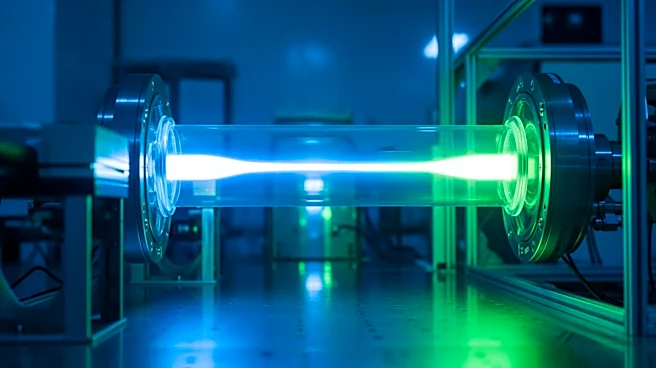
Researchers at the University of East Anglia have uncovered a previously unknown property of light that allows it to twist, spin, and behave in unusual ways without the need for mirrors, materials, or specialized
lenses. This discovery challenges long-standing assumptions about light's behavior and suggests that light can be 'programmed' by leveraging its inherent geometry. The research indicates that light can develop chiral behavior, acting like a left or right hand, while moving freely through space. This finding could have significant implications for medical diagnostics, data transmission, and future quantum systems. The study demonstrates that light can naturally develop handed behavior, which could enable it to carry information, examine biological systems, manipulate matter, and safeguard quantum signals.
Why It's Important?
The discovery of this new property of light has the potential to revolutionize various fields by providing a simpler and more efficient way to control light. In medical and pharmaceutical applications, it could lead to more sensitive tests, particularly in drug development, by distinguishing between left- and right-handed molecules. In communications, the ability to pack more information into laser beams could enhance data capacity and security, benefiting future quantum networks. Additionally, the research could lead to the development of compact optical sensors for quick and cost-effective identification of biological and chemical substances. The findings also suggest advancements in quantum technologies, as the topology of light could help protect delicate quantum information from noise and disruption.
What's Next?
The researchers suggest that their findings could lay the groundwork for a new generation of light-based technologies. By adjusting the topology of light, scientists can control how and where chirality appears, offering a new 'tuning knob' for light. This could lead to the development of advanced tools for biology and nanotechnology, allowing for the manipulation of tiny particles, cells, or molecules using light alone. The research team plans to explore further applications of this discovery, potentially leading to more robust and cost-effective technologies in various fields.
Beyond the Headlines
The implications of this discovery extend beyond immediate technological applications. The ability to control light using its internal geometry could lead to ethical and legal considerations, particularly in areas like data security and privacy. As light-based technologies become more prevalent, there may be a need for new regulations to address potential misuse or unintended consequences. Additionally, the cultural perception of light as a simple and familiar phenomenon may shift as its complex and powerful capabilities are further explored and understood.