



What's Happening?
Citizen scientists have identified three new odd radio circles (ORCs) in distant galaxy clusters, significantly expanding the known number of these rare astronomical phenomena. ORCs, first discovered in 2019, are colossal radio structures that can be up
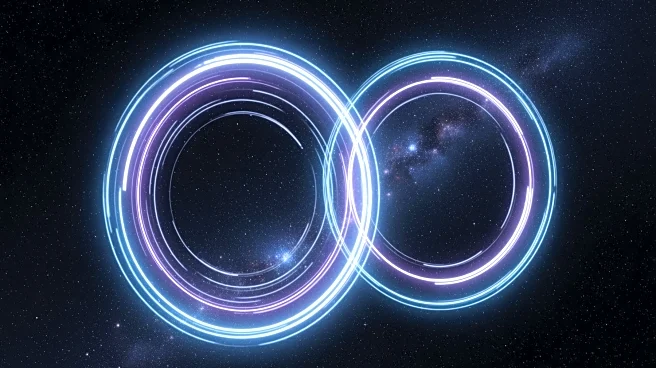
to 50 times larger than the Milky Way. These structures are invisible at optical, infrared, and X-ray wavelengths, detectable only through radio telescopes. The recent discoveries were made by participants of the RAD@home Astronomy Collaboratory in India, who analyzed radio data and identified unusual patterns. The findings were confirmed by the LOFAR radio telescope network. One of the newly discovered ORCs consists of twin rings, each 978,000 light-years in diameter, making it the most powerful ORC system observed to date.
Why It's Important?
The discovery of these ORCs is crucial for advancing our understanding of the universe, particularly the co-evolution of galaxies and black holes. These structures provide insights into the dynamic processes involving black holes, energetic jets, and dense galactic environments. The involvement of citizen scientists highlights the importance of human analysis in modern astronomy, even as artificial intelligence becomes more prevalent in data analysis. This collaborative approach not only democratizes scientific discovery but also enhances the potential for new findings that could reshape our understanding of cosmic phenomena.
What's Next?
The Square Kilometre Array, a vast network of radio telescopes set to begin operations in the early 2030s, is expected to identify many more ORCs. This project will significantly expand the catalog of these structures, offering deeper insights into their origins and evolution. The continued involvement of citizen scientists in such projects will likely lead to further discoveries, reinforcing the value of public participation in scientific research. As more ORCs are identified, researchers will be able to develop more comprehensive models of their formation and the role they play in the universe.