



What's Happening?
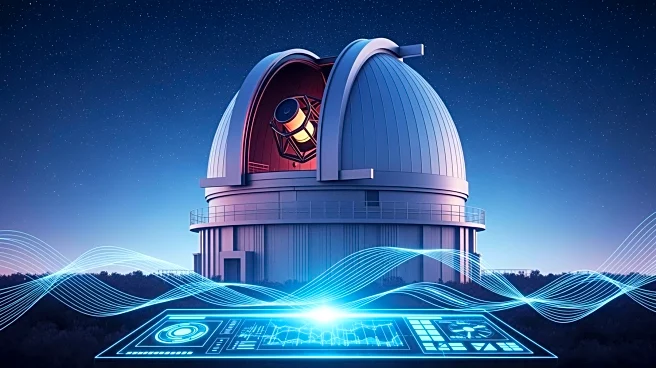
Recent advancements in the automation of optical transient discovery and classification are transforming time-domain astronomy in the Rubin era. The Zwicky Transient Facility (ZTF), supported by institutions like Caltech and the University of Washington,
plays a crucial role in this development. The facility utilizes advanced spectrographs and automated pipelines to enhance the detection and analysis of transient astronomical events. These innovations are supported by significant funding from the National Science Foundation and other organizations, enabling researchers to process vast amounts of data efficiently and improve the accuracy of transient classifications.
Why It's Important?
The automation of transient discovery is pivotal for the field of astronomy, as it allows for the rapid identification and study of transient events such as supernovae and gamma-ray bursts. This capability is essential for understanding the dynamic universe and contributes to advancements in astrophysics. The integration of automated systems reduces the time and labor required for data analysis, enabling astronomers to focus on interpretation and theory development. The collaboration between multiple institutions and the support from funding bodies highlight the importance of this research in advancing scientific knowledge and technological capabilities.