
What's Happening?
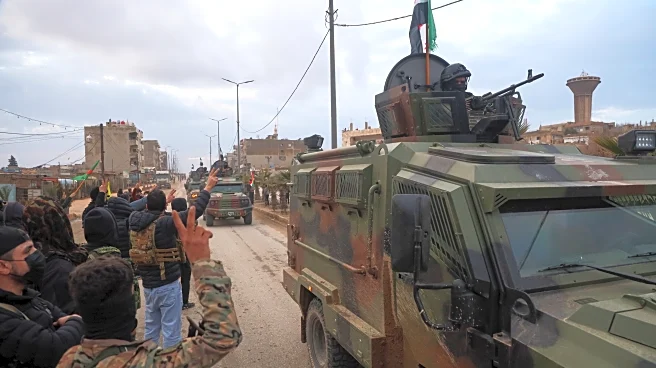
In Aleppo, Syria, intense clashes have erupted between the Syrian government forces and Kurdish fighters, leading to the evacuation of tens of thousands of residents from predominantly Kurdish neighborhoods,
Sheikh Maqsoud and Achrafieh. The Syrian military issued an ultimatum for civilians to leave these areas by 3 p.m. local time, after which the neighborhoods were declared a 'closed military area.' Following the deadline, explosions were reported, marking the deadliest escalation in recent violence between the two groups. The Syrian Democratic Forces (SDF), backed by the U.S., have accused government forces of attacking civilian areas and imposing a siege, while the government claims the military operations aim to secure the city and prevent armed activities. The conflict has resulted in numerous casualties and displaced over 46,000 people in the province.
Why It's Important?
The ongoing conflict in Aleppo highlights the fragile state of peace and security in Syria, particularly in regions with significant Kurdish populations. The clashes underscore the complexities of Syrian politics, where the SDF, a key U.S. ally against ISIS, is viewed as a terrorist organization by Turkey due to its links with the PKK. The violence disrupts efforts to integrate the SDF into the Syrian national army, a process that has seen little progress. The humanitarian impact is severe, with thousands displaced and essential services disrupted, exacerbating the already dire living conditions in the region. The situation also poses challenges for international diplomacy, as stakeholders like Turkey and the U.S. navigate their interests in the region.
What's Next?
The immediate future may see continued military operations in Aleppo as the Syrian government seeks to assert control over the contested neighborhoods. The lack of progress in talks between the SDF and the Syrian government suggests that further negotiations are needed to prevent prolonged conflict. International reactions, particularly from Turkey and the U.S., could influence the dynamics on the ground. Humanitarian organizations may need to increase their efforts to support displaced populations. The situation remains volatile, with potential for further escalations if diplomatic solutions are not reached.