
What's Happening?
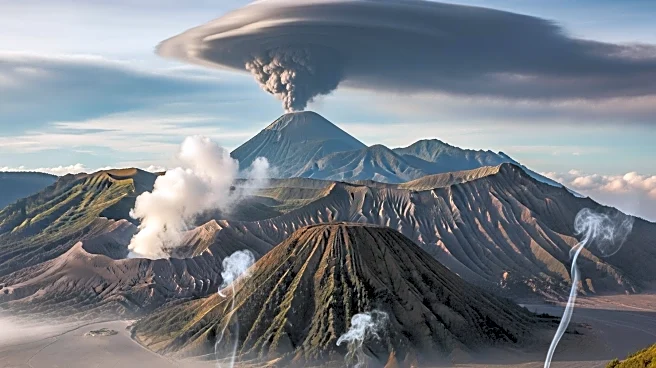
A recent study has examined the role of carbon emissions from volcanic arcs and their influence on Earth's climate over geological time scales. The research focuses on the carbon outgassing from carbonate
platforms and subducting slabs, which are significant contributors to atmospheric carbon levels. By reconstructing the intersections of carbonate platforms with subduction zones, the study estimates the historical carbon emissions from these geological features. The findings suggest that volcanic arc emissions have varied significantly over time, with a notable increase in emissions from carbonate platforms since 120 million years ago. This increase is attributed to the expansion of carbonate platform areas and changes in mantle melting rates. The study also highlights the role of mid-ocean ridges and continental rifts in carbon emissions, which have historically contributed to climate variations between icehouse and greenhouse states.
Why It's Important?
Understanding the historical carbon emissions from volcanic arcs is crucial for comprehending past climate changes and predicting future climate trends. The study's findings provide insights into the natural processes that have influenced Earth's climate over millions of years. By identifying the sources and rates of carbon emissions, researchers can better assess the impact of human activities on current climate change. The research underscores the importance of geological processes in the global carbon cycle and their potential to drive significant climate shifts. This knowledge is vital for developing more accurate climate models and informing policy decisions aimed at mitigating climate change.
What's Next?
Future research may focus on refining the estimates of carbon emissions from geological sources by incorporating additional data on carbonate platform thickness and sedimentary carbon budgets. Further studies could also explore the interactions between volcanic arc emissions and other climate drivers, such as ocean circulation and solar radiation. These efforts will enhance our understanding of the complex factors influencing Earth's climate and improve predictions of future climate scenarios. Additionally, the study's methodology could be applied to other regions and time periods to provide a more comprehensive picture of the Earth's climate history.
Beyond the Headlines
The study raises important questions about the long-term sustainability of Earth's climate systems and the potential for natural processes to counteract or amplify human-induced climate change. It highlights the need for a holistic approach to climate science that considers both natural and anthropogenic factors. The research also emphasizes the interconnectedness of Earth's systems, where changes in one component, such as volcanic activity, can have far-reaching effects on global climate patterns. This perspective is essential for developing effective strategies to address the challenges of climate change.