




What's Happening?
Victor Davis Hanson, a scholar at Stanford University’s Hoover Institution, has argued that Marjorie Taylor Greene and Tucker Carlson misinterpreted their informal relationships with President Trump, believing they held more influence over his policies
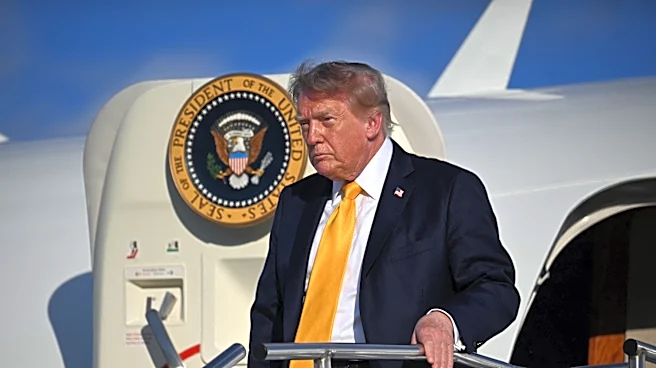
than they actually did. Speaking on 'Pod Force One,' Hanson suggested that both Greene and Carlson mistook President Trump's 'charm and graciousness' for an invitation to dictate policy. He noted that President Trump is 'very generous and gregarious' and 'treats everybody the same,' which can lead individuals to believe they are on an equal footing with him. Hanson explained that Greene and Carlson, having been in intimate settings with President Trump, such as Mar-a-Lago or Air Force One, began to think they could advise him on significant matters, forgetting his position as President of the United States. He cited instances where Carlson reportedly tried to influence President Trump's decisions on Iran, and Greene's repeated calls regarding the Epstein files, as examples of this misinterpretation.
Why It's Important?
This analysis by Victor Davis Hanson is important because it sheds light on the dynamics of power and influence within political circles, particularly concerning a figure like President Trump. It suggests that personal access and perceived intimacy do not necessarily translate into policy-making power, even for prominent media figures and politicians. This perspective offers insight into why certain individuals might experience a 'snap back' from President Trump when they overstep perceived boundaries, leading to strained relationships. For political observers, it highlights the distinction between informal interactions and formal advisory roles, emphasizing that a president's affability should not be confused with an open invitation to direct national policy. It also underscores the unique nature of President Trump's personal style, which can be interpreted differently by those around him, leading to potential misunderstandings about their actual influence.
What's Next?
This argument by Victor Davis Hanson is likely to fuel ongoing discussions about the nature of influence within President Trump's orbit and the broader political landscape. It may prompt other political commentators and former associates to reflect on their own interactions and perceived influence. For Greene and Carlson, this analysis could be seen as a critique of their past actions and their understanding of presidential power. It might also influence how future political figures and media personalities approach their relationships with powerful leaders, potentially leading to a more cautious assessment of their actual sway. The discussion could also contribute to a broader understanding of how informal access can be misconstrued in high-stakes political environments, impacting both personal relationships and public perceptions of influence.
Beyond the Headlines
Beyond the immediate political implications, Hanson's argument touches on deeper psychological and sociological aspects of power dynamics. It highlights how individuals can misinterpret social cues and personal interactions, especially when dealing with figures of immense authority. The 'trap' of mistaking informality for substantive influence is a common human tendency, amplified in the high-stakes world of national politics. This phenomenon can lead to disillusionment and conflict when expectations of influence are not met. Furthermore, it speaks to the unique charisma and communication style of President Trump, which, while fostering a sense of closeness, does not necessarily delegate authority. This dynamic can create a complex web of relationships where perceived loyalty and access are valued, but ultimate decision-making power remains centralized, leading to potential friction when those boundaries are tested.