



What's Happening?
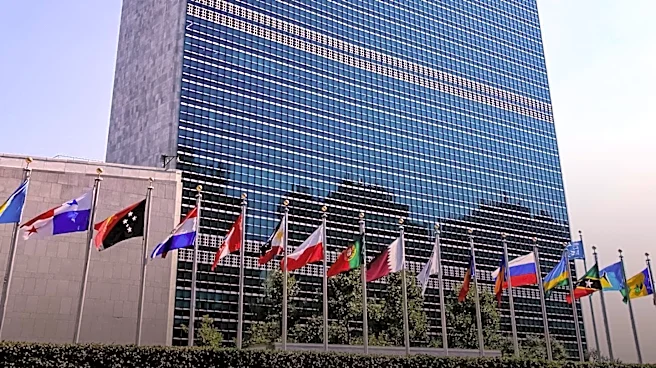
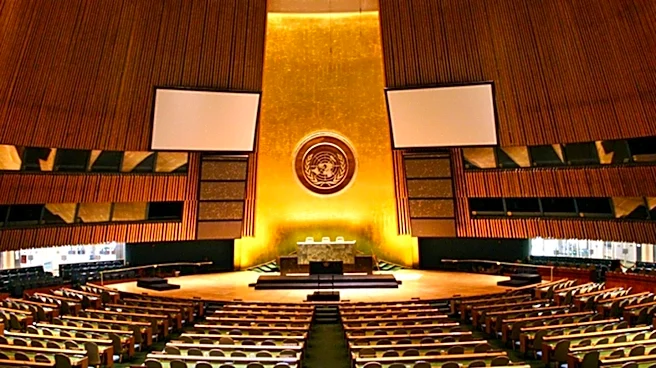
For the third consecutive year, the United Nations has adopted a resolution on artificial intelligence (AI) in the military domain, jointly led by Korea and the Netherlands. The resolution, titled 'Artificial Intelligence in the Military Domain and Its
Implications for International Peace and Security,' was passed by the first committee of the 81st U.N. General Assembly on October 30, with support from 171 member states. This year's resolution includes a provision for holding a 'structured dialogue' in Geneva in 2027 and 2028. These dialogues will bring together UN member states, international organizations, academia, civil society, and industry to discuss developments, transparency, confidence-building measures, and risk reduction strategies concerning military AI. The resolution also welcomed the establishment of the Centre of Excellence on AI, Peace and Security under the U.N. Institute for Disarmament Research.
Why It's Important?
The repeated adoption of this resolution underscores the growing international concern and commitment to addressing the implications of AI in military applications. As AI technologies advance rapidly, there is an urgent need to establish international norms and guidelines to prevent unintended escalation, ensure accountability, and maintain global peace and security. This resolution provides a crucial platform for multilateral discussions, fostering transparency and confidence-building among nations regarding the development and deployment of military AI. The structured dialogues planned for Geneva will facilitate deeper engagement among diverse stakeholders, helping to shape a common understanding and potentially leading to future international agreements or frameworks. The establishment of the Centre of Excellence further solidifies the UN's role in leading research and policy development in this critical area.
What's Next?
The adoption of this resolution sets the stage for significant international discussions on military AI in the coming years. The 'structured dialogues' scheduled for Geneva in 2027 and 2028 will be key events, bringing together a wide array of experts and policymakers. These dialogues are expected to delve into specific aspects of military AI, including ethical considerations, legal frameworks, and practical measures for risk reduction. The outcomes of these discussions could inform future UN initiatives, potentially leading to the development of international standards, codes of conduct, or even treaties governing the use of AI in warfare. Additionally, the Centre of Excellence on AI, Peace and Security will likely play a pivotal role in providing research and analysis to support these ongoing international efforts.
Beyond the Headlines
The UN's sustained focus on AI in the military domain reflects a broader global reckoning with the transformative, yet potentially destabilizing, power of artificial intelligence. This resolution goes beyond mere acknowledgment, pushing for concrete steps like structured dialogues and the establishment of a dedicated research center. It highlights the complex ethical dilemmas posed by autonomous weapons systems, the potential for algorithmic bias in decision-making, and the challenges of maintaining human control over lethal force. The international community is grappling with how to harness the benefits of AI while mitigating its risks in a domain as sensitive as national security. This ongoing process could redefine traditional concepts of warfare, arms control, and international humanitarian law, necessitating a fundamental shift in how nations approach defense and diplomacy in the age of AI.